Penetration testing: what a pentest is, how it runs and how to choose a provider
A pentest is a controlled attack carried out with written authorisation that checks whether security controls can be bypassed. We show how it differs from a vulnerability scan, how it runs in six stages, what the report should contain, which regulations require testing and what to ask a provider.
A penetration test (pentest) is a controlled attack on an organisation's systems, carried out with its written authorisation and within an agreed scope. Its purpose is to check whether the security controls can be bypassed and to prove it in practice. A vulnerability scanner produces a list of possible weaknesses. A tester checks which of them really lead to data, administrator accounts or a compromised application, and describes the path step by step. Below we explain how a pentest runs, what types there are, what the report should contain, which regulations require testing and how to choose a provider.
What a penetration test is
In its SP 800-115 guidance, NIST describes penetration testing as security testing in which assessors mimic real-world attacks to identify methods for circumventing the security features of a system. Two things follow from that. The tester acts as an attacker, not as an auditor with a checklist, and looks for ways around the controls. Practice and the law add a third: everything happens within limits the client has accepted in writing before the start.
A pentest is most often confused with vulnerability scanning. A scanner compares software versions and configurations against a database of known vulnerabilities and reports every match. It does not check whether the vulnerability is reachable or what can be done with it. A tester starts from the scanner's output. They verify the findings, discard false positives and look for links between weaknesses that look harmless on their own. For example: a default password on a panel on a test server, a service account with excessive privileges and no network segmentation. A scanner will report the first of these at most, and will usually not see the other two at all. Chained into a single path, they can lead from an ordinary account to domain administrator rights.
Two more terms that come up when commissioning work are audit and red team. An audit assesses whether an organisation is in control of its security: processes, policies, evidence. We cover the differences in more detail in our article on what a cybersecurity audit looks like (in Polish). A red team, according to the NIST glossary, is a group authorised to emulate a potential adversary's attack or exploitation capabilities, showing the impact of a successful attack and what works on the defensive side. A pentest aims to find as many vulnerabilities as possible within the agreed scope. A red team exercise tests whether the security team detects the attack and responds in time, so usually only a few people know about it. Bug bounty programmes and automated continuous testing can complement a pentest, but they do not provide an agreed scope or the report an auditor expects.
| Vulnerability scan | Penetration test | Red team | |
|---|---|---|---|
| Catches known vulnerabilities across the whole scope | ●yes, natively | ●yes, natively | ◐partial or via integration |
| Confirms that a vulnerability can be exploited | ○no | ●yes, natively | ●yes, natively |
| Chains minor weaknesses into an attack path | ○no | ●yes, natively | ●yes, natively |
| Tests whether the SOC detects the attack and responds | ○no | ◐partial or via integration | ●yes, natively |
| Can run continuously and automatically | ●yes, natively | ○no | ○no |
Vulnerability exploitation: one of the two main points of entry
In the Verizon Data Breach Investigations Report 2026 data, vulnerability exploitation was the most common point of entry: it accounted for 31% of breaches with a known entry vector. Abuse of stolen credentials fell to 13%. The same report states that over the period covered, organisations fully patched only 26% of critical vulnerabilities in the CISA KEV (Known Exploited Vulnerabilities) catalogue, compared with 38% a year earlier, and the median time to full remediation rose from 32 to 43 days.
CERT Polska data show the scale of the problem in Poland. Through the free moje.cert.pl service, CERT Polska scans domains and addresses registered by its users (institutions, companies and individuals). In over a year of operation it checked close to 3.5 million domains, subdomains and IP addresses and found more than 650,000 vulnerabilities and misconfigurations. The ENISA Threat Landscape 2025 report, based on a different sample of incidents, puts vulnerability exploitation (21.3%) second among points of entry, after phishing (60%). A scanner will tell you a vulnerability exists. Whether someone from outside can actually get through it, and how far they get, is something only a test can answer.
Types of penetration test
A pentest always has a specific target. Commissioning a "penetration test of the company" without saying what is to be tested usually ends in a shallow review of everything at once. Below are the six most commonly commissioned types. They can be combined in a single engagement.
| Type of test | What it checks | When it makes most sense |
|---|---|---|
| External infrastructure test | Services visible from the internet: VPN, email, admin panels, servers in the DMZ | Regularly, and after every change to internet-facing services |
| Internal network and Active Directory test | How far someone who is already on the network can get: a compromised account, an infected laptop, a dishonest employee | When the main risk is ransomware (in Polish) and domain takeover |
| Web application and API | Access control, business logic, authentication, code injection, the OWASP Top 10 categories | Before an application goes live and after major code changes |
| Mobile application | The app itself, data stored on the device and communication with the API | When the app handles payments, personal data or logins to company systems |
| Cloud environment | Account and role permissions, publicly accessible resources, service configuration | After a cloud migration and when several teams create resources on their own |
| Wi-Fi, physical security and social engineering | The guest network, getting into the office without a badge, an attempt to extract information over the phone | In offices with customer footfall, and wherever attacking people is easier than attacking systems |
For web applications the reference point is the OWASP Top 10. In the 2025 edition first place again goes to broken access control (A01: Broken Access Control), meaning situations in which a user can see or change something they should not have access to. A scanner usually does not find these flaws, because from its point of view the application is working correctly. Phishing campaigns covering the whole organisation are usually commissioned separately.
Black box, grey box and white box
The second decision is how much the tester knows at the start. In a black box test they know nothing beyond an address or the company name, like an outside attacker. In a grey box test they receive test accounts with different roles and basic documentation. In a white box test they have access to the source code, the architecture and the configuration.
Black box sounds the most realistic, but it has a weakness: a large part of the testing time goes on reconnaissance the client could simply have handed over. An attacker can study a target for weeks, while the tester's time is limited by the contract. That is why, with limited testing time, grey box usually yields more findings per day of work. Black box makes sense when the goal is precisely to see how much can be learned about the company from outside.
How a pentest runs, step by step
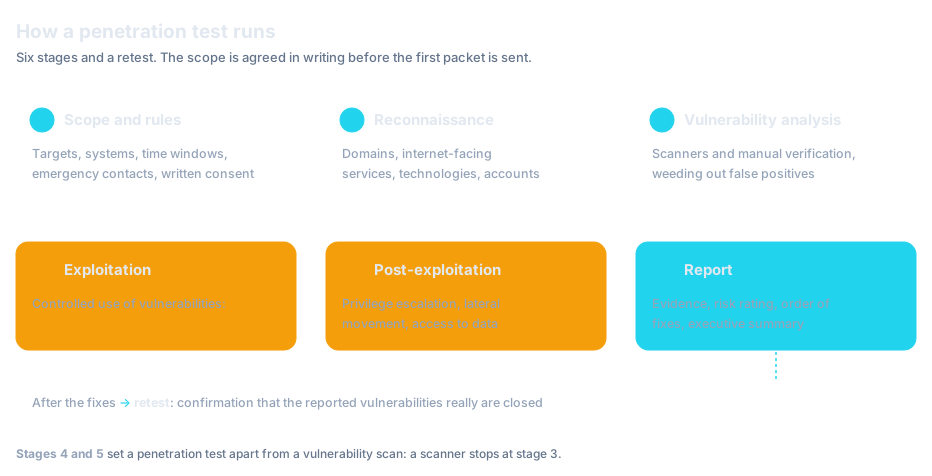
Several publicly available methodologies describe how a test runs. PTES (Penetration Testing Execution Standard) divides it into seven phases, from pre-engagement interactions to reporting. The OWASP Web Security Testing Guide, version 4.2, is the most widely used guide to web application testing, OSSTMM 3 covers operational security testing, and NIST SP 800-115, from 2008, has had no newer edition and remains a general guide to technical testing. In its technical guidance for Implementing Regulation (EU) 2024/2690, ENISA lists OWASP WSTG and OSSTMM among the standards worth taking into account when drafting a testing policy. In practice the process comes down to six stages.
- Stage 1Client and providerScope, rules and written authorisation
Agreeing what is tested, during which hours, by which methods and what must not be done. Plus emergency contacts on both sides and authorisation signed by a person empowered to give it. Mistakes made at this stage cannot be corrected during the test.
- Stage 2TesterReconnaissance
Gathering information about the target: domains and subdomains, internet-facing services, software versions, application technologies, email addresses and roles in the organisation. Some of this work can be done without sending a single packet to the systems under test.
- Stage 3TesterVulnerability analysis
The tester combines scanning with manual verification, weeds out false positives, draws up a list of candidates for exploitation and judges which attack paths are most promising. A vulnerability scanner on its own gets this far.
- Stage 4TesterExploitation
Controlled exploitation of vulnerabilities, so as to demonstrate that an attack is possible without harming the systems. Methods that put availability at risk, such as stress testing, need separate approval and a time window.
- Stage 5TesterPost-exploitation
Checking where the foothold leads: privilege escalation, lateral movement to other systems, access to data. This answers the question the board cares about: what could an attacker realistically do.
- Stage 6Tester, then the clientReport and debrief
A description of each finding with evidence, a risk rating and a recommendation, an executive summary and a meeting at which the technical team can ask about the details. Once fixes have been deployed, the tester can carry out a retest.
Scope and rules of engagement
The rules of engagement document protects both sides. The client knows what to expect and whom to notify about a worrying event. The tester knows where their authorisation ends. A well-prepared document contains several elements.
- The list of IP addresses, domains, applications and accounts in scope, and explicit exclusions
- Testing hours, and whether production or a copy of it is being tested
- Permission or prohibition for tests that may affect service availability
- Contact persons on both sides in case of problems, and response times
- What happens when a critical vulnerability or traces of an earlier intrusion are found
- Rules for handling personal and confidential data the tester reaches, and the deadline for deleting it
Written authorisation and the Polish Criminal Code
Under Polish law, what separates a pentest from a break-in is authorisation. Article 267 of the Criminal Code (Kodeks karny; consolidated text Dz.U. 2026 poz. 1342) penalises anyone who, without authorisation, gains access to information by breaking or bypassing its security, and anyone who without authorisation gains access to all or part of an IT system. The contract and the consent of the system's owner give the tester that authorisation. Without them the tester is exposed to criminal liability, and the exceptions described below are narrow.
Since 2017 the Criminal Code has contained two exceptions for people acting solely to secure a system. Article 269b § 1a provides that no offence is committed by someone who produces, obtains, sells or makes available programs or devices adapted to committing computer crimes, or passwords and access codes, if they act solely to secure a system or to develop a method of securing it. Article 269c in turn provides that a person who gains access to a system (Article 267 § 2) or disrupts its operation (Article 269a) is not punishable if they acted solely to secure the system, promptly notified its owner of the threats uncovered, and their action did not harm the public or a private interest and caused no damage. This exception does not cover Article 267 § 1, that is, breaking security in order to reach information. It is a narrow opening for researchers who check other people's systems in good faith without a commission and report the vulnerabilities they find. It is not a basis for commissioning tests. That basis is always written authorisation and a documented scope.
- The system runs at a provider. A SaaS application, hosting or a cloud service belongs to someone else. The test needs that party's consent too, or has to follow the testing rules it has published
- The authorisation is signed by someone without the power to give it. An IT manager cannot always consent to a test of a system whose business owner is another department or another company in the group
- The scope is described in general terms. "The company's infrastructure" without a list of addresses does not protect the tester when they hit a server that belongs to someone else
How to prepare an organisation for a pentest
Part of the work before a test lies with the client, and when it is missing the start date usually slips or the results narrow. A well-prepared test starts with a few things.
- Test accounts for every role the tester is to check, and access to the environment on the agreed date
- Up-to-date backups of the systems under test
- Notification to the hosting or cloud provider, if its terms require it
- A decision on whether the SOC team and administrators know about the test, or whether the test should also check their response
- One person on the organisation's side who answers the tester's questions and can make decisions quickly
What a penetration test report should contain
The report is the only document that remains after the test, and its quality determines whether the team will know what to fix. It should have two layers: a summary from which the board understands the level of risk and the priorities, and a technical section from which the IT team can reproduce and fix each finding. Implementing Regulation (EU) 2024/2690 under the NIS2 Directive requires the digital service providers it covers to document the type, scope, time and results of each test, including a criticality assessment and mitigating actions for each finding.
- An executive summary: the main risks and what to fix first, without jargon
- A description of the scope, methodology, dates and limitations of the test, that is, what was not checked
- For each finding: a description, its location, evidence (a screenshot, a request, the system's response) and steps to reproduce it
- A risk rating with a rationale, not just a number on a scale
- A specific remediation recommendation instead of a generic "update the software"
- A description of attack paths, if several weaknesses could be chained
- An indication of which findings were confirmed manually and which come only from tools
Risk rating: CVSS is the starting point
Reports most often rate findings on the CVSS scale. FIRST published the current version, CVSS 4.0, on 1 November 2023. Scores range from 0 to 10.
| Rating | Score |
|---|---|
| None | 0.0 |
| Low | 0.1–3.9 |
| Medium | 4.0–6.9 |
| High | 7.0–8.9 |
| Critical | 9.0–10.0 |
The number alone is not enough to set the order of fixes. The same vulnerability means one thing on an internet-facing server and another in an isolated test environment. CVSS 4.0 provides environmental metrics for this, but many reports give only the base score. A good report explains why a given finding is dangerous in this particular organisation and orders the fixes by real risk.
Retest: proof that the fixes work
Once fixes have been deployed, the tester checks the same findings again. A retest catches fixes that close one variant of an attack but leave another open, and provides proof that vulnerabilities have been closed, which an auditor or supervisory authority may ask for. PCI DSS explicitly requires the test to be repeated after corrections (requirement 11.4.4).
When a penetration test is required
Few regulations use the words "penetration test" outright. Most require systems to be tested and the effectiveness of controls to be assessed, and a pentest is one of the simplest ways to demonstrate that. Below is an overview of the regulations most often behind a commission.
| Regulation | What it requires | How often |
|---|---|---|
| The National Cybersecurity System Act (ustawa o krajowym systemie cyberbezpieczeństwa, KSC) as amended in 2026 (Dz.U. 2026 poz. 252), Article 8(1)(2)(b) and (h) | As part of the information security management system (ISMS) (in Polish): testing of the information system, and policies and procedures for assessing the effectiveness of security measures (important entities that are public entities apply the simplified ISMS in Annex 4 to the act) | The act sets no testing frequency; it follows from the risk assessment. An essential entity carries out a security audit at least once every 3 years (Article 15) |
| The NIS2 Directive, Article 21(2)(e) and (f), and Implementing Regulation 2024/2690, points 6.5 and 7 of the Annex | A security testing policy: the need for, scope, frequency and type of tests set on the basis of risk, with a documented methodology | Based on risk. Regulation 2024/2690 applies only to the digital service providers it lists: DNS, TLD registries, cloud, data centres, CDNs, managed services and managed security services, online marketplaces, search engines, social networks and trust services |
| DORA, Articles 24–26 of Regulation 2022/2554 | A testing programme with appropriate tests every year of systems supporting critical or important functions; the catalogue of possible tests (Article 25) includes penetration testing; for entities designated by the supervisor, advanced threat-led penetration testing (TLPT) | At least once a year (except for microenterprises); TLPT at least every three years, and the authority may change the frequency |
| PCI DSS v4.0.1, requirement 11.4 | Internal and external penetration testing and segmentation testing, performed by a qualified, organisationally independent tester (internal or external) | Every 12 months and after any significant change; segmentation every 6 months for service providers |
| KRI (Krajowe Ramy Interoperacyjności, the National Interoperability Framework), Regulation of 21 May 2024 (Dz.U. 2024 poz. 773), § 19(2)(14) | A periodic internal information security audit in a public entity; a pentest is sometimes part of it, but the provision does not mandate one | At least once a year |
The amended KSC Act (Chapter 6a) allows CSIRT MON, CSIRT NASK, CSIRT GOV and the sectoral CSIRTs to carry out a security assessment of the systems of entities in the national cybersecurity system, that is, security tests aimed at detecting vulnerabilities. Such an assessment takes place with the entity's consent or at the request of the competent cybersecurity authority. An organisation should know its vulnerabilities before a CSIRT points them out.
In the financial sector, TLPT under DORA is carried out in accordance with Delegated Regulation 2025/1190, and the European TIBER-EU framework was aligned with these requirements in 2024. We write more about the regulation itself in our article on DORA requirements, and about who the act covers in our article on NIS2 and the KSC Act.
Regulations rarely mandate a pentest outright. They require testing and proof that controls work. A penetration test report is one of the simplest pieces of evidence that an organisation does this, provided it has a documented scope, methodology and confirmation that the findings have been fixed.
How often to run penetration tests
PCI DSS requires a test at least once every 12 months and after any significant change. DORA requires appropriate tests of systems supporting critical or important functions at least once a year, and a penetration test is one of the possible ones. The KSC Act and NIS2 leave the decision to risk analysis, and for internet-facing systems an annual cycle is a sensible benchmark. A significant change is, for example, a new application, a cloud migration, a network redesign or a connection to the systems of an acquired company.
A pentest shows the state of things in one particular week. Between tests there should be continuous exposure management (in Polish), including vulnerability scanning, and a process that turns its results into fixes. The median of 43 days to fully patch critical vulnerabilities in the DBIR data shows that the latter is often harder than finding the problem. While a fix is being prepared, a web application can be shielded by a WAF with virtual patching.
How to choose a penetration testing firm
Penetration testing proposals can differ widely for what looks like the same scope, because the same name is used to sell both several days of work by an experienced tester and a scanner run with its output translated. Before signing a contract it is worth asking a few questions.
- Who exactly will do the testing (which pentester), and what experience and certifications they hold, for example OSCP or OSWE (OffSec), CREST CRT or CCT, GIAC GPEN
- Which methodology the test follows (PTES, OWASP WSTG, OSSTMM), and whether the report will demonstrate compliance with the requirement you have to meet
- Whether you can see an anonymised sample report
- How much of the time goes on manual work and how much on automated tools
- Whether the scope includes a retest, and how soon after the report it can be carried out
- How the provider protects the data it reaches during the test, and when it deletes it
- Whether it holds third-party liability insurance that covers testing
- What it will do if it finds a critical vulnerability or traces of an ongoing attack during the test
Certifications confirm the skills of specific people, not of the whole firm, which is why asking who is on the team matters more than a list of logos in the proposal. Independence counts too. PCI DSS requires the test to be performed by a qualified internal or external tester with organisational independence, and DORA requires tests to be carried out by independent internal or external parties, with no conflict of interest. The team that built an application should not test it itself.
Warning signs in a proposal
Be wary of a proposal based solely on the number of IP addresses and prepared without any conversation about scope, a delivery time shorter than reconnaissance alone would take, no rules of engagement document, and a promise of a "security certificate" after the test. A penetration test certifies nothing. It shows what could be found in a given time and scope. If the sample report looks like a tool export, with hundreds of items, no evidence and no description of attack paths, that is most likely how it was produced.
What the scope and duration of a penetration test depend on
The duration of a test follows from the testers' working time, which depends on several factors. That is why a reliable schedule only emerges after a conversation about scope.
- Size of the scope: the number of applications, user roles, API endpoints, addresses and locations
- Depth of the test: black box, grey box or white box with code review
- Types of test in a single engagement, for example an application and internal infrastructure together
- Working conditions: testing outside business hours, in production or with constraints imposed by providers
- Formal requirements: a report for a specific standard or supervisory authority, TLPT under DORA
- The retest and the debrief with the team
The least value comes from a badly scoped test: too broad to check anything thoroughly, or leaving out the system through which an attacker could actually get in. That is why it is worth starting from a list of systems and the question of which intrusion the organisation fears most, and only then settling the details of the test. The scope and course of our tests are described on our page on penetration testing and web application assessment.
Frequently asked questions
What is a pentest?
A pentest (penetration test) is a controlled attack on an organisation's systems, carried out with its written authorisation and within an agreed scope, intended to show in practice whether and how the security controls can be bypassed.
How does a penetration test differ from vulnerability scanning?
A scanner automatically compares versions and configurations against a database of known vulnerabilities and reports every match. A tester verifies those findings, discards false positives, exploits vulnerabilities in a controlled way and chains minor weaknesses into attack paths. They also find logic and access control flaws that a scanner cannot see.
Is penetration testing legal?
Yes, if the tester acts under a contract and the written authorisation of the system's owner, within the documented scope. Article 267 of the Polish Criminal Code penalises gaining access to a system without authorisation, and the owner's consent provides that authorisation. When the system runs at a provider, for example in the cloud or as SaaS, the provider's consent is also needed, or the test has to comply with its testing rules.
How often should penetration tests be run?
Usually at least once a year and after every significant change, such as a new application, a cloud migration or a network redesign. PCI DSS requires a test every 12 months and after a significant change, and DORA requires annual testing of systems supporting critical or important functions. The KSC Act and NIS2 leave the frequency to risk analysis. Between tests it is worth running continuous vulnerability scanning.
Can a pentest damage systems?
The risk exists, which is why it is limited in the rules of engagement: time windows, excluding methods that threaten availability without separate approval, emergency contacts on both sides and a decision on whether production or a copy of it is tested. Exploitation is only meant to prove that an attack is possible, without carrying it out in full.
Which regulations require penetration testing?
PCI DSS requires penetration testing explicitly (requirement 11.4, every 12 months and after a significant change). DORA lists it among the tests in a digital operational resilience programme, run for critical systems at least once a year, and requires selected entities to carry out TLPT at least every three years. The Polish KSC Act and the NIS2 Directive require systems to be tested and the effectiveness of controls to be assessed, and a pentest is one of the simplest ways to demonstrate that. The KRI requires public entities to carry out an annual internal information security audit.
What should a penetration test report contain?
An executive summary, a description of the scope, methodology and limitations of the test, and for each finding the evidence, steps to reproduce it, a risk rating with a rationale and a specific remediation recommendation. A good report also describes attack paths and distinguishes findings confirmed manually from those that come only from tools.
Summary
A penetration test answers a question that neither a scanner nor an audit asks: can someone from outside, or from inside the network, actually get through the controls, and how far will they get. Its value depends on what was agreed before the first packet: a well-defined scope, written rules and a provider that delivers a report with evidence rather than a tool export. After the test the real work begins, namely the fixes and the retest.
KEY TAKEAWAYS
- 1A pentest is a controlled attack with written authorisation that proves in practice whether the security controls can be bypassed; a vulnerability scanner only reports possible weaknesses
- 2Vulnerability exploitation accounts for 31% of breaches in the Verizon DBIR 2026 data and was the most common point of entry there; in the ENISA data it ranks second, after phishing
- 3The value of a test is decided by the scope and rules agreed before the start, and in Poland the written authorisation of the system's owner is what separates a test from an offence under Article 267 of the Criminal Code
- 4A good report has an executive summary, evidence and a recommendation for each finding, a risk rating in the context of the organisation, and a retest after the fixes
- 5DORA and PCI DSS require testing at least once a year, while the KSC Act and NIS2 require systems to be tested and the effectiveness of controls to be assessed on the basis of risk
Sources
- 1.Technical Guide to Information Security Testing and Assessment (NIST SP 800-115)NIST · 2008-09 · accessed 2026-10-24Definition of penetration testing and the general course of technical testing; a 2008 document with no newer edition. Definition of a red team from the NIST glossary (CNSSI 4009-2022).
- 2.Penetration Testing Execution Standard (PTES)PTES · accessed 2026-10-24Seven phases: pre-engagement interactions, intelligence gathering, threat modelling, vulnerability analysis, exploitation, post-exploitation, reporting.
- 3.
- 4.
- 5.OSSTMM 3 – The Open Source Security Testing Methodology ManualISECOM · accessed 2026-10-24
- 6.CVSS v4.0 Specification DocumentFIRST · 2023-11-01 · accessed 2026-10-24Severity ratings: table 22 of the specification.
- 7.2026 Data Breach Investigations Report – Executive SummaryVerizon · 2026-05 · accessed 2026-10-24Vulnerability exploitation as the point of entry in 31% of breaches, credential abuse 13%; 26% of critical vulnerabilities in the CISA KEV catalogue fully patched (38% a year earlier); median time to full remediation 43 days (32 a year earlier). Data from 10.2024–11.2025; entry vector shares calculated for breaches with a known vector.
- 8.Prawie 2 tys. zgłoszeń każdego dnia. Raport CERT Polska za 2025 rokCERT Polska / NASK · 2026-04-08 · accessed 2026-10-24The moje.cert.pl scanner: close to 3.5 million domains, subdomains and IP addresses checked, more than 650,000 vulnerabilities and misconfigurations found. Cumulative data for over a year of the service, given in an announcement of 8 April 2026. Text in Polish.
- 9.ENISA Threat Landscape 2025ENISA · 2025-10-01 · accessed 2026-10-24Phishing (60%) and vulnerability exploitation (21.3%) as the two main points of entry; 4,875 incidents from 07.2024–06.2025.
- 10.Ustawa z dnia 23 stycznia 2026 r. o zmianie ustawy o krajowym systemie cyberbezpieczeństwa oraz niektórych innych ustaw (Dz.U. 2026 poz. 252)ISAP / Sejm RP · 2026-03-02 · accessed 2026-10-24Article 8(1)(2)(b) and (h): testing of the information system, policies for assessing the effectiveness of measures; Article 15(1): audit of an essential entity at least once every 3 years; Chapter 6a, Articles 36a–36b: security assessment carried out by a CSIRT with the entity's consent or at the request of the authority. Text in Polish.
- 11.Dyrektywa Parlamentu Europejskiego i Rady (UE) 2022/2555 (NIS2)Dziennik Urzędowy UE · 2022-12-27 · accessed 2026-10-24Article 21(2)(e): security in network and information systems acquisition, development and maintenance, including vulnerability handling; point (f): policies and procedures to assess the effectiveness of cybersecurity risk-management measures; Article 21(5): the list of providers covered by the implementing act.
- 12.Technical Implementation Guidance on cybersecurity risk-management measures, version 1.0ENISA · 2025-06-26 · accessed 2026-10-24Guidance on Implementing Regulation (EU) 2024/2690 with the text of point 6.5 of the Annex (security testing); OWASP WSTG and OSSTMM among the standards to take into account in a testing policy.
- 13.Rozporządzenie Parlamentu Europejskiego i Rady (UE) 2022/2554 (DORA)Dziennik Urzędowy UE · 2022-12-27 · accessed 2026-10-24Article 24(4): tests carried out by independent internal or external parties; Article 24(6): appropriate tests at least once a year; Article 25(1): the list of tests, including penetration testing; Article 26(1): TLPT at least every three years. Regulatory technical standards for TLPT: Commission Delegated Regulation (EU) 2025/1190.
- 14.TIBER-EUEuropejski Bank Centralny · accessed 2026-10-24TIBER-EU updated in 2024 to align fully with the regulatory technical standards on TLPT under DORA.
- 15.PCI DSS v4.0 Self-Assessment Questionnaire D for Service Providers (tekst wymagań 11.4)PCI Security Standards Council · 2022-04 · accessed 2026-10-24Wording of the 11.4 requirements from the PCI SSC document for version 4.0; version 4.0.1 is currently active. 11.4.2 and 11.4.3: testing every 12 months and after a significant change, organisational independence of the tester; 11.4.4: repeat testing after corrections; 11.4.5 and 11.4.6: segmentation testing, every 6 months for service providers.
- 16.Rozporządzenie Rady Ministrów z dnia 21 maja 2024 r. w sprawie Krajowych Ram Interoperacyjności (Dz.U. 2024 poz. 773)Sejm RP (ELI) · 2024-05-22 · accessed 2026-10-24§ 19(2)(14): a periodic internal information security audit, at least once a year. Text in Polish.
- 17.Obwieszczenie w sprawie ogłoszenia jednolitego tekstu ustawy – Kodeks karny (Dz.U. 2026 poz. 1342)Sejm RP (ELI) · 2026-10-16 · accessed 2026-10-24Article 267 § 1 and 2, Article 269b § 1a and Article 269c; the exceptions for action taken to secure a system were introduced by the Act of 23 March 2017 (Dz.U. 2017 poz. 768). Text in Polish.
Want to know how far an attacker would get?
We run manual penetration tests of networks, web applications and APIs, and cloud configuration reviews following OWASP, PTES and OSSTMM, with a report for the technical team and for the board.