Vishing in 2026: Why Voice Phishing Is Now the Top Cloud Breach Vector
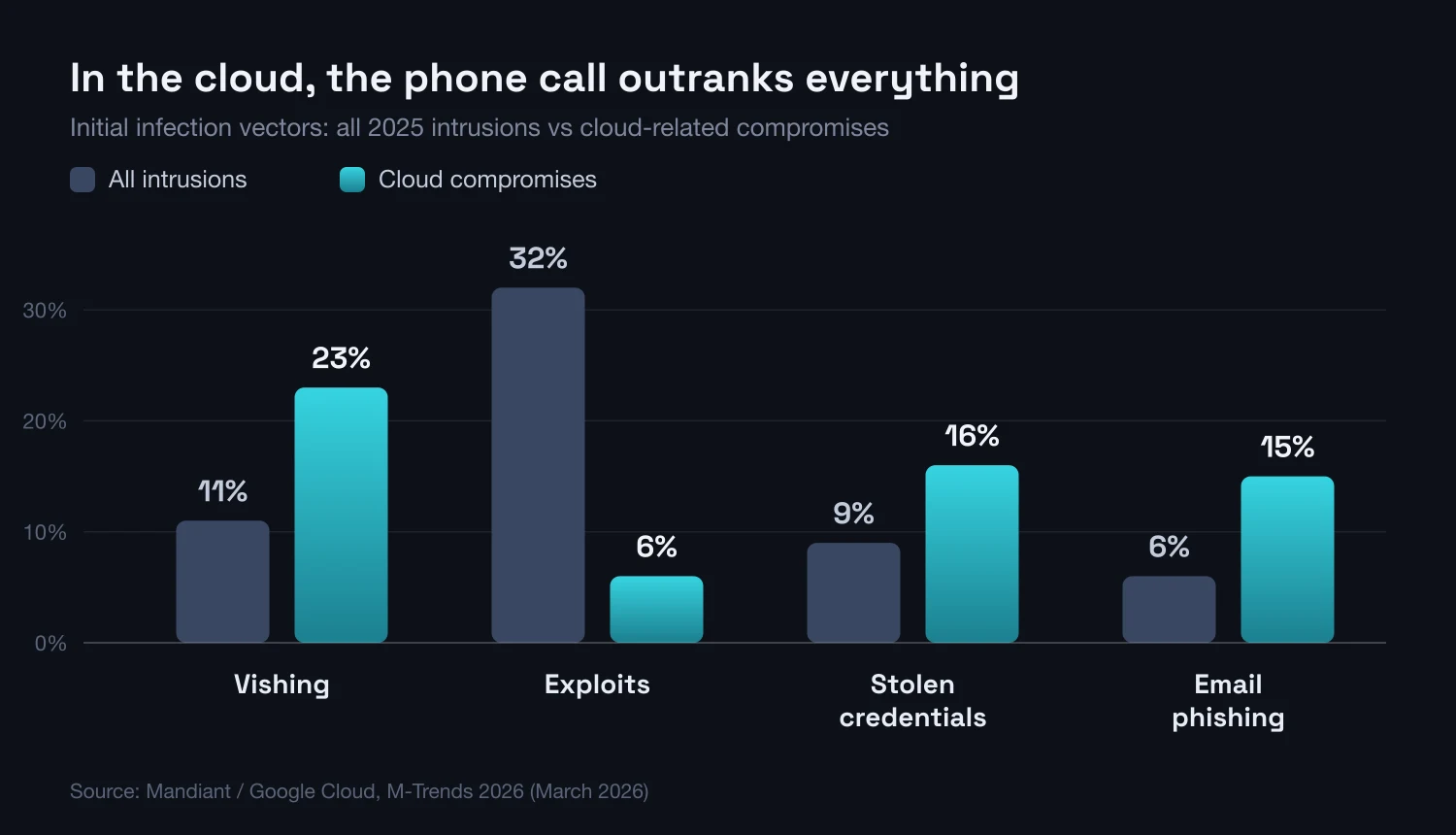
Vishing accounts for 11% of all intrusions and 23% of cloud compromises, where it ranks first. Why email controls do not transfer to the phone, how MFA resets are talked out of the help desk, which caller verification methods hold up, and what to do in the first hour after an incident.
Vishing, phishing carried out over the phone, was the second most common initial infection vector of 2025: 11% of all intrusions Mandiant investigated, and 23% of cloud compromises, where it ranks first. The reason is mundane. A call cannot be scanned. No headers, no attachment, no link. The only control that works is a caller verification procedure, plus a person who knows they may apply it to the boss as well.
Vishing is now the second initial access vector
M-Trends 2026, built on more than 500,000 hours of incident response conducted by Mandiant during 2025, ranks the vectors unambiguously. Exploits come first for the sixth consecutive year, at 32%. Voice phishing follows at 11%. Vishing did not overtake exploits, but it overtook everything else: prior compromise, stolen credentials and email phishing.
The second number is more interesting than the first. Email phishing fell from 14% in 2024 to 6% in 2025 — not sampling noise but a consistent decline. Gateways, sandboxing and link rewriting did their job: the economics of a bulk mail campaign collapsed faster than the cost of standing up a fraudulent call centre.
In the cloud the proportions look entirely different. There, vishing accounts for 23% of compromises and is the number one vector, ahead of third-party compromise (17%), stolen credentials (16%) and email phishing (15%). Exploits drop to 6%. The explanation is simple: in SaaS there is little to exploit from the network side, but there is a help desk that can reset MFA.
The Verizon 2026 DBIR looks at the same phenomenon from another angle and lands in the same place. The human element appears in 62% of breaches, social engineering is the third most common incident pattern (16%), and pretexting — building trust through a concocted scenario, in the report's words "frequently by voice communications" — entered the rankings as its own vector at 6%. In simulations, the median success rate of mobile-centric channels, voice and SMS, is 40% higher than the same scenario sent by email.
Why the phone works where email stopped working
Email controls have nothing to carry over to the voice channel. A filter works because the message is an artefact: headers, a sender, a domain, an attachment, a link. Every one of those can be checked against reputation, a pattern and a sandbox before the user sees it. A call has none of them, and leaves behind no object that could be scanned after the fact.
Not a metaphor but a concrete list of what this channel lacks:
- No artefact to analyse — no file, no URL and no SPF, DKIM or DMARC header; nothing to send to a sandbox
- No trace to search afterwards — without a recording, the logs hold call metadata at best
- Caller ID is not authentication — CLI can be spoofed, and CERT Polska warns about it plainly: "Do not blindly trust the displayed number or the name of the caller"
- The conversation is interactive — the attacker reacts to hesitation, changes the argument, raises or eases the pressure
- Time pressure applies instantly — you can leave an email for an hour, but a phone line holds a silence someone has to fill
- Authority is asserted, not verified — "I am calling from the security team" sounds identical whether or not it is true
M-Trends says it outright: although email and voice phishing both sit under the social engineering umbrella, "the distinction between the two is crucial for defenders: interactive attacks are significantly more resilient against automated technical controls and require different detection strategies." The budget that went into the mail gateway bought no control on this channel.
Anatomy of the attack: from a message to a hijacked account
A typical campaign does not start with a call. It starts with a message engineered to provoke one, and that sequence sidesteps the controls on both channels at once. The four steps below follow the flow described in the joint FBI and CISA advisory on Scattered Spider and in Proofpoint research on TOAD.
A lure with no payload — a message that contains only a number
The message impersonates a supplier, an IT department or a bank and reports a locked account, a failed sign-in or an invoice that needs clarifying. It carries no link and no attachment, only a number for "support". Proofpoint puts it plainly: the message looks benign, and the attack chain activates only once the victim dials it themselves.
The callback — the victim dials the number
A fraudulent call centre picks up. The fact that the victim initiated contact disarms suspicion more effectively than any pretext: in their mind they called the company. The scale of this channel is industrial — Proofpoint puts it at an average of 10 million TOAD messages a month, peaking above 13 million in August 2023.
Pretext and pressure — a script run by a human or an AI agent
The caller describes an irregularity, sets a clock ("we have ten minutes before the system locks the account") and steers towards one of three actions: reading out a one-time code, approving a push prompt, or installing a remote access tool. CERT Polska records exactly this variant in Polish campaigns.
Using the access — the code replayed before it expires
The code spoken aloud is typed into the real sign-in page while the conversation is still running. If the target was the help desk rather than the user, the result is a password reset and the MFA method moved to the attacker's device. The account is taken over while the victim is still on the line, believing they have just avoided an incident.
TOAD: the email a gateway has no way to block
Telephone-Oriented Attack Delivery is the name for a message that exists purely as a pretext for a call. Proofpoint describes the mechanism without embellishment: it contains "nothing more than a phone number and some erroneous information", and the chain activates only when the victim dials. Criminal call centres guide callers into granting remote access, revealing credentials or infecting themselves with malware.
From a mail gateway's point of view this message is clean. No URL to check against reputation, no file for the sandbox, no macro to defuse. What remains is content and sender-context analysis — precisely the layer where generative language models removed the last easy signals: awkward phrasing, grammatical slips and unnatural word order.
- The financial variant — the caller talks the victim into installing legitimate remote access software, takes the desktop and operates their banking; the screen is sometimes blanked to hide the activity
- The malware variant — the victim downloads a "diagnostic tool" from a dictated address, which delivers a loader and, further down the chain, ransomware
- The corporate variant — the prize is not money in an account but a one-time code or an approved MFA prompt that opens the tenant
- The reverse variant — contact starts with the call, and the email or SMS arrives afterwards as "confirmation"
Awareness programmes badly misjudge the scale of this channel. Proofpoint reports that 23% of surveyed organisations run smishing and vishing simulations, so fewer than one in four rehearse the scenario that ranks first in the cloud. A programme that stops at clicking links drills a behaviour attackers no longer need from this set of targets.
The help desk is the target, because it holds the MFA reset
The biggest problem is not that an employee reads out a code. It is that the help desk resets MFA at the request of someone whose identity nobody verified. The joint advisory from the FBI, CISA, RCMP, ACSC, AFP, CCCS and NCSC-UK on Scattered Spider, in its 29 July 2025 update, describes this as a core technique of the group: the actors pose as employees to convince help desk staff to reset the password and transfer the MFA token to a device they control.
Microsoft tracks the same group as Octo Tempest and adds the detail that decides whether the call succeeds: the attackers research the organisation beforehand, mimic the idiolect of a specific person and hold enough personal information to pass standard knowledge questions. They have also been seen impersonating new hires, where "I do not have access yet" raises no suspicion.
| Verification method | Resistance to vishing | What breaks it | Operational cost |
|---|---|---|---|
| Knowledge questions: date of birth, employee number, line manager's name | Negligible | Open-source research, leaked HR data, a LinkedIn profile — the attacker knows the answers before dialling | Very low, a few seconds of the call |
| Caller ID (CLI) display | None | Number spoofing; CERT Polska warns against treating CLI as proof of identity | Zero, but the value is zero too |
| Hanging up and calling back on a number from the corporate directory | High | A forward configured on the PBX, or number takeover through a SIM swap | Low, one extra call per ticket |
| Video verification with an ID document checked against the HR photo | High | Real-time video deepfakes in the hands of a well-prepared attacker | Medium, adds several minutes to the ticket |
| Confirmation by the line manager over a channel independent of the ticket | High | A compromised manager account, or an absent manager which forces the procedure to be bypassed | Medium, depends on management availability |
| Confirmation from a previously registered device or FIDO2 key | Very high | Physical loss of the key, which still requires a documented fallback path | High once at rollout, low in day-to-day operation |
The operational cost column matters here as much as resistance. A procedure that adds ten minutes to every ticket becomes something to work around within a week of rollout, especially on a ticket from a board member. The sensible compromise is tiering: routine requests after one verification, password resets and MFA re-enrolment after two independent ones, and privileged accounts only through a path where the help desk cannot act alone.
// 1. Authentication methods changed by somebody other than the account owner.
//    This is the signature of a reset talked out of the help desk: actor != target.
AuditLogs
| where TimeGenerated > ago(30d)
| where LoggedByService == "Authentication Methods"
| where OperationName has_any ("registered security info", "updated security info",
                               "deleted security info")
| extend Actor  = tostring(InitiatedBy.user.userPrincipalName)
| extend Target = tostring(TargetResources[0].userPrincipalName)
| where isnotempty(Actor) and isnotempty(Target) and Actor != Target
| project TimeGenerated, Actor, Target, OperationName, Result, CorrelationId
| order by TimeGenerated desc

// 2. An admin-driven password reset followed within the hour by a successful
//    sign-in from a country the user has not signed in from before. That gap is
//    the tail end of a hijack that started as a phone call.
let resets = AuditLogs
    | where TimeGenerated > ago(30d)
    | where OperationName has "Reset user password" and Result == "success"
    | project ResetTime = TimeGenerated,
              Target = tostring(TargetResources[0].userPrincipalName),
              Admin  = tostring(InitiatedBy.user.userPrincipalName);
let baseline = SigninLogs
    | where TimeGenerated between (ago(90d) .. ago(30d)) and ResultType == 0
    | summarize KnownCountries = make_set(tostring(LocationDetails.countryOrRegion))
        by UserPrincipalName;
SigninLogs
| where TimeGenerated > ago(30d) and ResultType == 0
| extend Country = tostring(LocationDetails.countryOrRegion)
| join kind=inner resets on $left.UserPrincipalName == $right.Target
| where TimeGenerated between (ResetTime .. ResetTime + 1h)
| join kind=leftouter baseline on UserPrincipalName
| where isnull(KnownCountries) or Country !in (KnownCountries)
| project TimeGenerated, UserPrincipalName, Country, IPAddress, ResetTime, Admin

// 3. A help desk operator whose reset volume spikes well above their own norm.
//    Not an incident by itself, but it is the cheapest metric that catches a
//    campaign aimed at one support seat rather than at one user.
AuditLogs
| where TimeGenerated > ago(90d)
| where OperationName has_any ("Reset user password", "registered security info")
| extend Admin = tostring(InitiatedBy.user.userPrincipalName)
| where isnotempty(Admin)
| summarize Daily = count() by Admin, Day = bin(TimeGenerated, 1d)
| summarize AvgDaily = avg(Daily), PeakDaily = max(Daily), ActiveDays = count() by Admin
| where PeakDaily > 3 * AvgDaily and ActiveDays > 5
| order by PeakDaily descThese queries will not detect the conversation. They detect its consequences. That is the only place vishing produces telemetry: an authentication method changed by someone other than the account owner, a password reset immediately followed by a sign-in from an unfamiliar country, and a help desk operator suddenly handling a multiple of their usual reset volume. If nobody reads those signals daily, that is the scope covered by SOC-as-a-Service.
Voice cloning: what is proven and what is a demonstration
It is worth separating research from marketing here. "From One Stolen Utterance", presented at the IEEE Symposium on Security and Privacy in 2025, tested five voice cloning techniques against eight voice authentication systems and thirty human listeners, using voice data from more than 7,000 speakers. The conclusion: modern cloning deceives both verification systems and people, and detection does not keep pace with new generators.
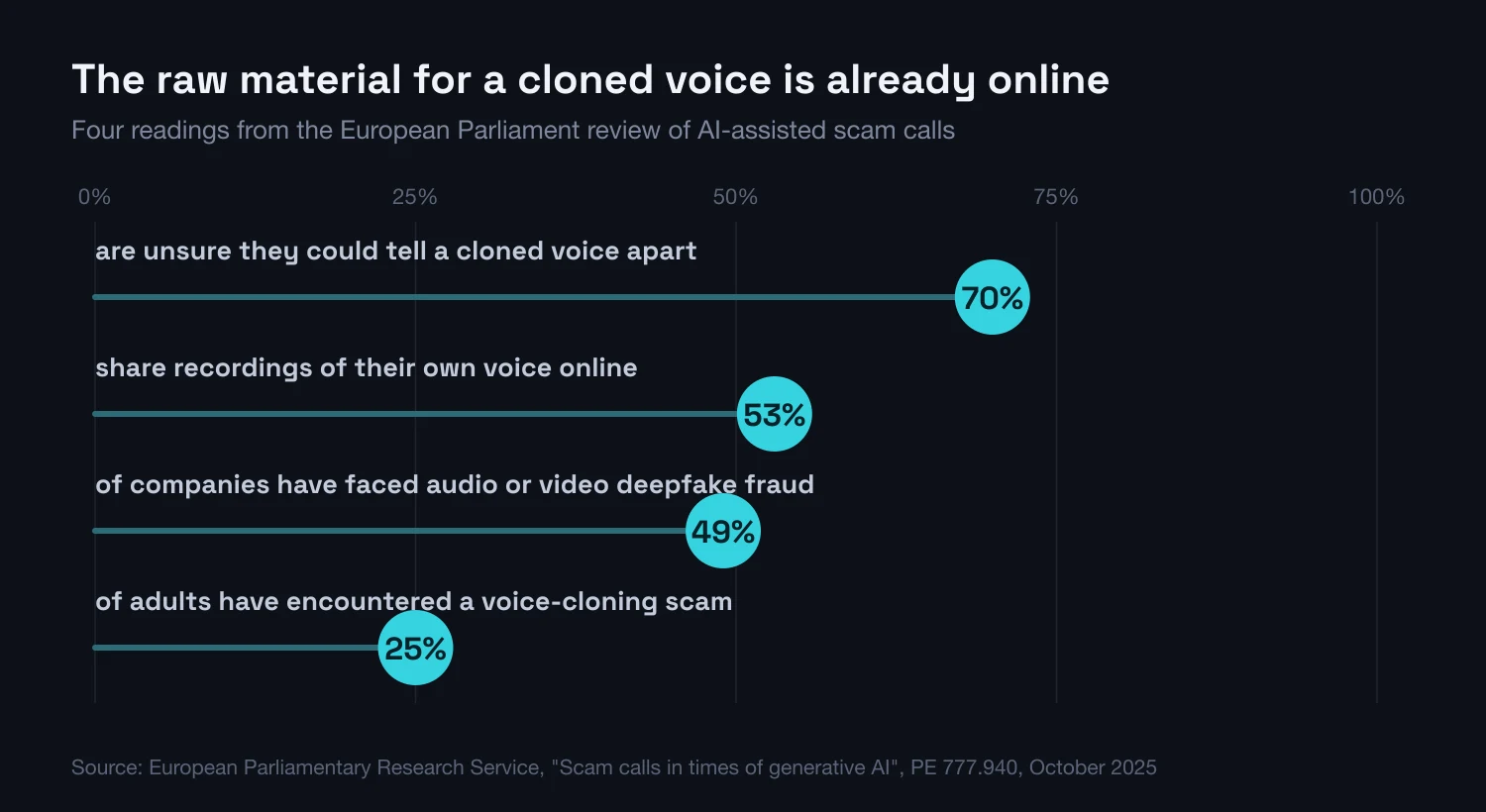
The review prepared for the European Parliament adds the market context. 53% of people share recordings of their own voice online, 70% of adults are unsure they could tell a clone from the original, and one in four has encountered a voice-cloning scam. On top of that, 49% of companies in the surveyed countries have faced fraud involving audio or video deepfakes.
Where does the line between demonstration and real use fall? Confirmed cases centre on financial fraud and impersonation of public figures. The FBI IC3 described a campaign in which actors sent text messages and "AI-generated voice messages" impersonating senior US officials. Europol reported an operation in which more than 7,500 calls were intercepted, preventing losses above 10 million euro in over 80% of cases.
What the data does not support is that a cloned voice is now the default component of corporate vishing. In the published accounts of Scattered Spider and Octo Tempest, the edge comes from reconnaissance and mimicking how someone speaks, not from speech synthesis. The conclusion is identical either way: since the voice has stopped being proof of identity, no procedure can treat it as authentication.
A real call from IT or your bank versus an attack
The differences are not in how the voice sounds but in what the caller asks for and how they react to being interrupted. The comparison below draws on guidance from CERT Polska and the FBI IC3 and on the joint Scattered Spider advisory.
- Calling back on the number the caller gave you. That is not verification, only confirmation that you reached the same person. Call back exclusively on a number from the corporate directory, the institution's official website, or the back of your payment card.
- Treating caller ID as proof. CLI can be spoofed, and CERT Polska warns about it plainly. The number on the display carries as much evidential weight as the "From" field in an email.
- Accepting a familiar voice as authentication. A manager's voice on the line was never an authentication factor, before the cloning era or after it. Authorising a payment or a change of bank details has to rest on a callback channel, not on recognising a tone of voice.
- Punishing people for hanging up. If an employee is reprimanded for putting the phone down on "the CEO", no procedure survives. The right to hang up has to be stated explicitly by the board.
The first 60 minutes after someone was talked into it
The report usually sounds like this: "I think I just read someone the code from my text messages." From that moment the order of operations is what matters, because a stolen session and a re-enrolled MFA method both survive a password reset. The flow below assumes one identity provider and the usual cast: user, help desk, security team.
- Minutes 0–5User and help deskReport the call, do not try to fix it yourself
The employee reports the call even if unsure whether they disclosed anything. The help desk does not investigate; it takes the report and escalates. Note the number that called, the time and what was requested — those three facts are enough to start searching the logs.
- Minutes 5–15Security teamRevoke sessions and tokens, not just the password
Force a password reset, then revoke every active session and refresh token for that identity. A password reset on its own leaves the attacker in place for as long as the refresh token lives. If continuous access evaluation is in use, confirm the revocation actually propagated to the applications.
- Minutes 15–30Security teamCheck MFA methods and registered devices
List the authentication methods and devices registered against the account over the past 30 days. Anything added during the call window, or just after it, has to go. This is the step most often skipped, and it decides whether the attacker returns despite the changed password.
- Minutes 30–45Security teamEstablish the blast radius: mailbox, rules, files, permissions
Check mailbox rules and forwarding created after the call, file access logs, permission changes and new OAuth application consents. If the account held directory roles, extend the review to operations performed with those roles. Preserve the findings before you start cleaning up.
- Minutes 45–60Security, HR and communicationsWarn the rest of the organisation and decide on notifications
The same campaign almost never calls once. Send out a warning with specifics — which pretext was used and what was requested — and check whether others received similar calls. In parallel assess the notification obligations: a personal data breach to the supervisory authority within 72 hours, a significant incident under your sector rules. Do not punish the person who reported it.
If within that hour it turns out the attacker managed to register their own MFA method or perform operations with administrative privileges, this stops being a help desk ticket. That is the point to invoke incident response and to treat identity, not the workstation, as the primary scope of the investigation.
Controls that genuinely reduce the risk
Vishing is a problem of process and permissions, not of tooling. The most effective controls are organisational and require no new product — they require a decision about who is allowed to do what, and on whose request. The list below runs from the cheapest to the most demanding to roll out.
- Write down and publish the caller verification procedure — one verification for routine requests, two independent ones for password resets and MFA re-enrolment, a separate path for privileged accounts
- Take away the help desk's ability to re-enrol an MFA method alone — require a second person or confirmation from the line manager over a channel independent of the ticket
- Agree a challenge phrase at hiring and store it outside the user directory, so a compromised account does not hand over the verification answers
- Define a callback channel for financial decisions — changes of bank details and payments above a threshold confirmed by calling a number from the supplier register, never one given during the call
- State the right to hang up explicitly — a message from the board that hanging up and calling back will never count against anyone
- Alert on MFA method changes and device registrations, with a separate threshold for operations performed by an account other than the owner
- Move privileged accounts to phishing-resistant authentication — FIDO2/WebAuthn keys or certificate-based authentication, named in the advisory as the only methods resistant to push bombing and SIM swapping
- Reduce the material that makes a pretext easy — a public org chart, internal extension numbers and named departmental lists are ready-made reconnaissance
- Rehearse the voice channel, not just the inbox — simulations that measure who discloses information under pressure, not only who clicked
The cost spreads across lines that no single licence replaces. The first is help desk time: extra verification lengthens each ticket, so it is costed against monthly ticket volume rather than as abstract procedural overhead. The second is hardware for phishing-resistant authentication: the number of keys, the issuing path and the procedure for a lost one. The third is integration: alerts from the identity directory have to land where somebody reads them.
The fourth line is the one most often forgotten: upkeep. Challenge phrases need rotating, the supplier register needs an owner, and simulation scenarios wear out after a few repetitions. Better to anchor this in a cycle, for instance through vCISO, than treat it as a one-off project. Resistance to a specific pretext is measured through social engineering simulations that include the voice channel; vishing also features in our guide to the types of phishing, alongside spear phishing and whaling.
KEY TAKEAWAYS
- 1Vishing is the #2 vector overall and #1 in the cloud — 11% of intrusions Mandiant investigated in 2025 and 23% of cloud compromises
- 2The phone wins because it leaves no artefact — no header, link or attachment to inspect, so the controls that hardened the inbox have nothing to carry over
- 3The help desk is the real target, not the user — a password reset and an MFA method moved to a chosen device take one call instead of a technical chain
- 4Caller verification is the only control that scales on this channel — with a cost measured in ticket handling time, not in licences
- 5Voice cloning is proven in research and confirmed in financial fraud, but in corporate campaigns the edge more often comes from reconnaissance than synthesis
- 6The voice has stopped being proof of identity — if authorisation rests on recognising the caller, it is not a procedure but a habit
Frequently asked questions about vishing
How does vishing differ from phishing and smishing?
Vishing is social engineering carried by voice: a phone call or a voice message. Phishing uses email, and smishing uses text messages. The difference is operational rather than terminological — email and SMS leave an artefact that can be scanned, while a call leaves nothing. All three are compared in our guide to the types of phishing.
Is caller ID reliable?
No. The number on the display can be spoofed, and CERT Polska warns explicitly against treating it as proof. The only reliable method is to hang up and call back on a number from an independent source: the corporate directory, the institution's official website, or the back of your card. Calling back on a number the caller supplied verifies nothing.
How much recorded audio is enough to clone someone's voice?
Research presented at the IEEE Symposium on Security and Privacy in 2025 showed that a single stolen utterance is enough for current tools to produce a clone effective against voice verification systems and human listeners alike. The consequence is simpler than any number of seconds: since 53% of people share recordings of their voice online, the source material usually already exists.
Does MFA protect against vishing?
It protects against password theft alone, but not against a call whose purpose is a one-time code or an approved push prompt. What resists this are phishing-resistant methods: FIDO2/WebAuthn keys and certificate-based authentication, identified in the CISA and FBI advisory as immune to push bombing and SIM swapping. An MFA reset talked out of the help desk is a separate problem that no authentication method solves, only a procedure.
How do you verify help desk callers without paralysing support?
By tiering. Routine requests take one verification; password resets and MFA re-enrolment take two independent ones, for example a callback on a directory number plus confirmation from the line manager. Privileged accounts should follow a path where the help desk cannot act alone. The cost is measured in ticket handling time, so measure it before rollout.
What should you do immediately after an employee reads out a code?
Force a password reset, then revoke every session and refresh token — the reset alone does not evict the attacker. Next, check the MFA methods and devices registered during the call window, review mailbox rules and application consents, and warn the rest of the organisation. The full sequence is set out in the runbook in this article.
Does vishing only affect large companies?
No. TOAD campaigns are mass-market — Proofpoint puts them at an average of 10 million messages a month — and the "bank employee" scenario described by CERT Polska targets individuals and small businesses. What differs is the prize: in a large organisation it is access to the tenant, in a small one usually money from the account or remote access to a computer.
Does recording inbound calls solve the problem?
It helps the investigation but prevents nothing. A recording exists only after the fact and does not change the decision made during the call, and for calls to personal phones it does not exist at all. It does have value on the help desk: it lets you reconstruct which knowledge questions were asked and whether the procedure was followed.
Conclusion
The shift from email to the phone is not a surprise but a consequence of email controls starting to work. Attackers moved to the channel with no gateway, no headers and nothing to scan. The defence has to move with them: into a caller verification procedure, into limiting what the help desk can do on a telephone request, and into rehearsing the scenario that now ranks first in the cloud. No technical control will answer that phone for you.
A phone call cannot be patched and cannot be scanned. The only control that scales past a single person on this channel is a procedure that states plainly what the help desk will not do over the phone — and a board that has confirmed hanging up will never be the wrong call.
Sources
- 1.M-Trends 2026 Executive EditionMandiant / Google Cloud · 2026-03 · accessed 2026-08-09More than 500,000 hours of Mandiant incident response during 2025; initial infection vector shares and the help desk training recommendation.
- 2.How to stop AI voice clones from bypassing your security perimeterGoogle Cloud · 2026-06-12 · accessed 2026-08-09Google Cloud article stating directly that vishing accounted for 23% of all cloud-related security incidents in M-Trends 2026.
- 3.M-Trends 2026: Initial Access Handoff Shrinks From Hours to 22 SecondsSecurityWeek · 2026-03-24 · accessed 2026-08-09A news outlet, cited by exception: the cloud vector split (third party 17%, credentials 16%, email 15%, exploits 6%) is published only in the gated full M-Trends 2026 edition.
- 4.2026 Data Breach Investigations Report — Executive SummaryVerizon · 2026-05 · accessed 2026-08-09More than 31,000 incidents and 22,000 confirmed breaches across 145 countries; the human element, pretexting, and voice simulation success rates.
- 5.Scattered Spider (AA23-320A)FBI, CISA, RCMP, ACSC, AFP, CCCS, NCSC-UK · 2025-07-29 · accessed 2026-08-09Joint advisory from seven agencies, updated 29 July 2025; employee impersonation against the help desk and phishing-resistant MFA.
- 6.Senior U.S. Officials Continue to be Impersonated in Malicious Messaging Campaign (I-121925-PSA)FBI IC3 · 2025-12-19 · accessed 2026-08-09A campaign using text messages and AI-generated voice messages, with the recommended way to verify a caller independently.
- 7.Scam calls in times of generative AI (PE 777.940)European Parliamentary Research Service · październik 2025 · accessed 2026-08-09Sharing of voice samples, confidence in spotting a clone, the share of companies hit by deepfakes, and a Europol operation.
- 8.From One Stolen Utterance: Assessing the Risks of Voice Cloning in the AIGC EraIEEE Symposium on Security and Privacy 2025 · 2025-05 · accessed 2026-08-09More than 7,000 speakers, five cloning techniques, eight voice authentication systems and thirty human listeners.
- 9.2024 State of the PhishProofpoint · 2024 · accessed 2026-08-09TOAD campaign volume, the payload-free message mechanism, and the share of organisations rehearsing smishing and vishing.
- 10.Protecting customers from Octo Tempest attacks across multiple industriesMicrosoft Threat Intelligence · 2025-07-16 · accessed 2026-08-09Octo Tempest: pre-call reconnaissance, idiolect mimicry, and impersonation of new hires.
- 11.Fałszywi konsultanciCERT Polska · accessed 2026-08-09The "fake consultant" scenario: number spoofing, time pressure, the request for remote access, and the call-back advice.
Protect your executives from attacks like VENOM
Arsen provides AI-powered phishing simulations, QR code attack testing, and executive-specific training — exactly the defenses recommended against this campaign.