The DORA Regulation: What a Financial Entity Actually Has to Do
DORA has applied since 17 January 2025 and covers nearly every supervised financial entity in the EU. The five pillars, the incident reporting clock, and what supervisors actually ask for.
DORA is a regulation, not a directive, so it has applied directly since 17 January 2025. Poland's national act is in place too: the provisions giving the KNF its inspection and sanctioning powers took effect on 7 August 2025. There is nothing left to wait for at either level.
What DORA is
DORA is Regulation (EU) 2022/2554 of the European Parliament and of the Council of 14 December 2022 on digital operational resilience for the financial sector. The name stands for Digital Operational Resilience Act. It has applied since 17 January 2025.
The premise is straightforward. Finance runs on IT systems and on the suppliers of those systems, so digital resilience stops being an IT department concern and becomes part of financial stability. DORA puts responsibility for it on the management body, which in practice means the board.
The regulation applies directly, but national law still has a job to do: name the supervisor and set the penalties. In Poland that came with the act of 25 June 2025 on digital operational resilience of the financial sector, published on 6 August and in force from 7 August 2025. It is what gives the KNF the concrete inspection and sanctioning powers described below.
Who it covers
The scope is broad and covers essentially the whole supervised financial market. In Poland the supervisor is the KNF. The rules apply to, among others:
- banks and credit institutions
- investment firms and brokerage houses
- insurance and reinsurance undertakings
- payment institutions and e-money institutions
- fund managers and pension funds
- crypto-asset service providers
- third-party ICT providers serving any of the above
That last entry catches people out. DORA reaches beyond the financial sector into the technology suppliers that serve it. If your company provides software or services to banks, the service-level and audit requirements will arrive through contracts whether or not you are a supervised entity yourself.
The five pillars
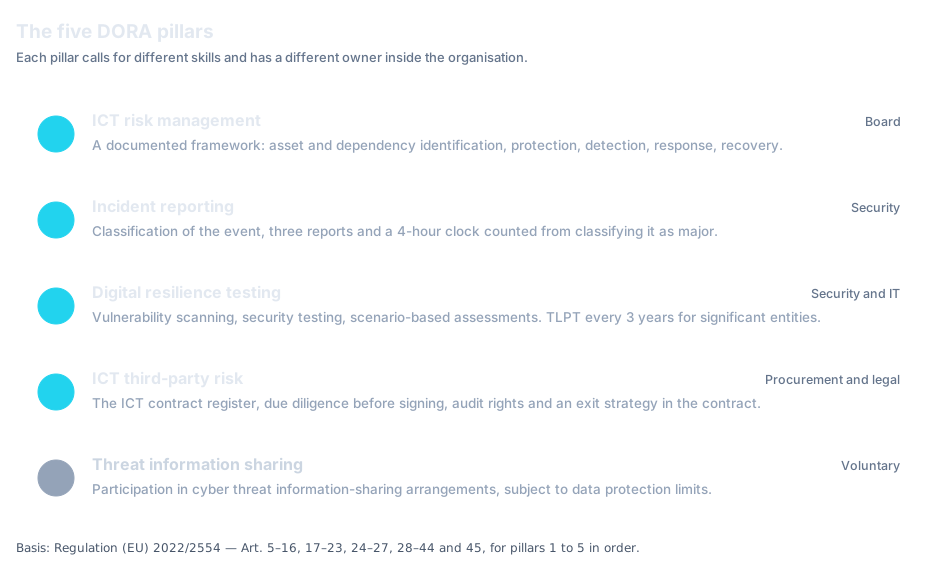
The requirements are usually grouped into five areas. The split is useful for planning, because each pillar needs different skills.
1. ICT risk management
You need a documented risk management framework: identifying assets and dependencies, protection, detection, response and recovery. Responsibility sits with the management body and cannot be delegated to a supplier. The board is also expected to keep its own knowledge of ICT risk current.
2. Incident reporting
You need a process for detecting, classifying and reporting ICT-related incidents. Classification criteria come from Delegated Regulation (EU) 2024/1772, reporting content and deadlines from Delegated Regulation (EU) 2025/301, and the forms themselves from Implementing Regulation (EU) 2025/302. Deadlines are below.
3. Digital resilience testing
A testing programme is required, covering vulnerability scanning, security testing and scenario-based assessment. Significant entities additionally run threat-led penetration testing, or TLPT, on a three-year cycle. This is the area we cover through security assessments and pen testing.
4. Third-party risk
You need a register of ICT supplier contracts, kept on the templates in Implementing Regulation (EU) 2024/2956, due diligence before signing, and contractual terms on service levels, audit rights, incident notification and exit strategies. Providers designated as critical fall under oversight at European level: the ESAs published the first list on 18 November 2025, covering 19 providers from cloud hyperscalers to telecoms operators. The registers submitted by financial entities are exactly what the criticality assessment was built on.
5. Information sharing
This pillar is voluntary. DORA encourages participation in threat intelligence sharing arrangements between financial entities, subject to data protection and competition rules.
Major incident reporting deadlines
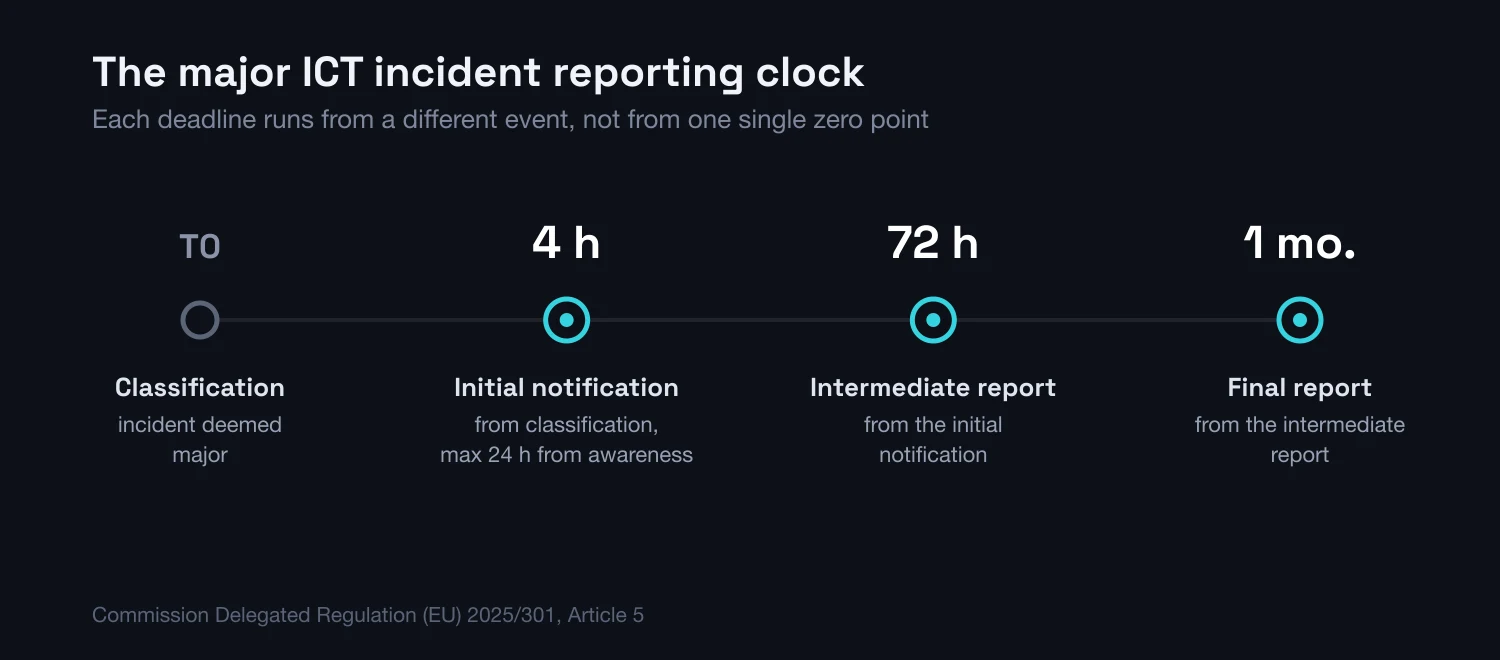
This is the most common question, so here it is concretely. There are three reports, but the clock starts earlier, when you classify the incident as major:
Classifying the incident
First you determine whether the incident meets the major criteria under Regulation 2024/1772. Factors include the number of clients affected, duration, geographic spread, losses and impact on critical services.
Initial notification
Goes to the supervisor within 4 hours of classifying the incident as major, and no later than 24 hours from the moment the entity became aware of it.
Intermediate report
Within 72 hours of the initial notification. By this point it carries real findings: what happened, how far it reached, what remediation is underway.
Final report
No later than one month after the last intermediate report or after the incident is closed. It covers root cause and lessons learned.
| Report | Deadline | Counted from |
|---|---|---|
| Initial notification | 4 hours, and no later than 24 hours from becoming aware of the incident | Classifying the incident as major |
| Intermediate report | 72 hours | The initial notification |
| Final report | One month | The last intermediate report, or the closure of the incident |
| Significant cyber threat notification | No deadline, the notification is voluntary | Not applicable |
Four hours reads reasonably on paper and very differently at 2am on a Sunday. The hard part in practice is not the form, it is establishing within that window whether the incident even meets the major threshold. Without round-the-clock detection, for example through SOC-as-a-Service, that clock starts running before anyone has noticed the event.
What the single entry point would change
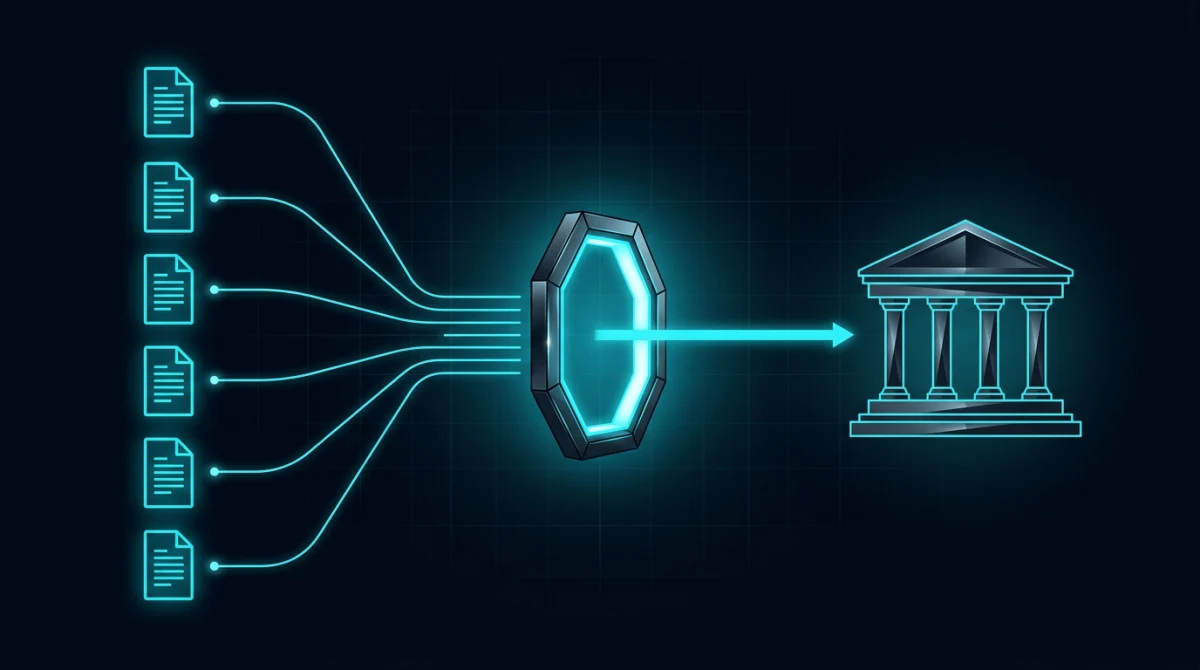
On 19 November 2025 the European Commission proposed the Digital Omnibus package, which includes a single entry point for incident reporting operated by ENISA. One notification would eventually satisfy obligations under DORA, NIS2, the GDPR, the eIDAS Regulation, the CER Directive and the Cyber Resilience Act at once. For a financial entity that files with the KNF through SOID and then separately with the data protection authority over the same event, that is a real simplification.
It is a long way off, though. The AI part of the package was split out and adopted as Regulation (EU) 2026/1744, while the part covering the GDPR, NIS2 and DORA is still in negotiation. The entry point itself is due to go live 18 months after the rules enter into force, extendable by another six months. Until then the existing channels apply and the deadlines in Regulation 2022/2554 stand unchanged. Design your 2026 and 2027 reporting process as though the single entry point did not exist.
What supervisors expect
Poland's KNF runs a dedicated DORA section and, more usefully day to day, operates two separate reporting systems. Confusing them costs hours precisely when there are none to spare:
- Major ICT incidents and significant cyber threats go through the DORA Incident Handling System (SOID) at csirt.knf.gov.pl
- If SOID is unavailable, the report goes to incydenty.dora@knf.gov.pl on the form KNF publishes
- All other DORA reporting, including the ICT supplier contract register, goes through the DORA Reporting System (SSD) at crp.knf.gov.pl
- The full set is expected: initial notification, intermediate report and final report
- The contract register is submitted on a recurring cycle, with each round's deadline announced separately in the DORA news section
- Interpretation questions go to konsultacje.dora@knf.gov.pl
- Smaller entities may use a simplified ICT risk management framework, which does not exempt them from incident reporting
Penalties
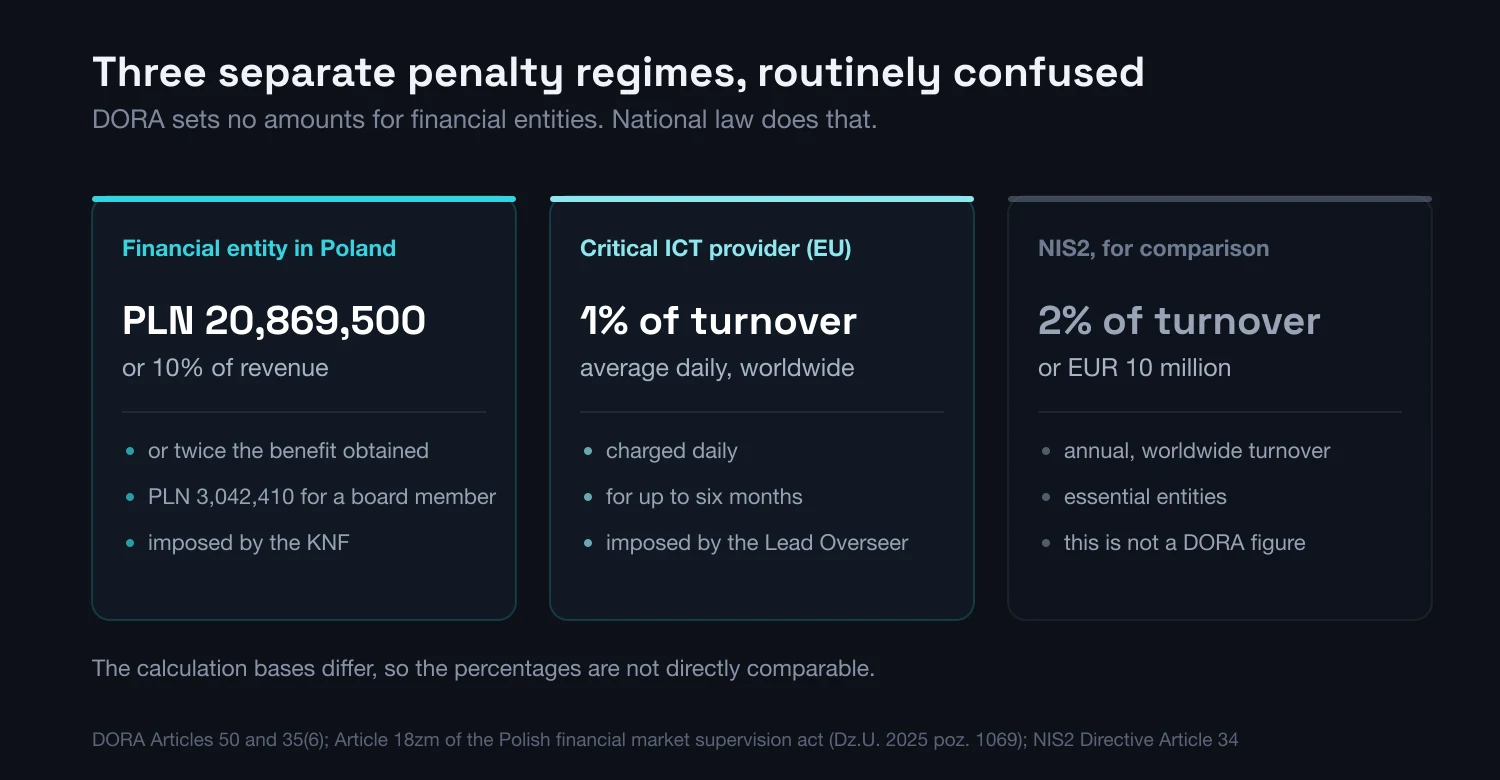
This is where the wrong numbers circulate, so take it in order. DORA itself sets no amounts for financial entities: Article 50 requires Member States to provide penalties that are effective, proportionate and dissuasive, and leaves the figures to them. In Poland they sit in Article 18zm of the financial market supervision act, inserted by the act of 25 June 2025: the KNF can impose up to PLN 20,869,500, or up to 10% of the revenue shown in the last approved annual accounts, or up to twice the benefit obtained, and up to PLN 3,042,410 on a board member responsible for the breach.
The supplier side works differently. A critical ICT third-party provider falls under European oversight, and under Article 35(6) the Lead Overseer can impose periodic penalty payments of up to 1% of average daily worldwide turnover in the preceding business year, charged daily for up to six months. It is not a one-off sum, and it has nothing to do with the 5 million euro figure that circulates in industry decks.
- EUR 5 million as a penalty for a financial entity. No such figure appears in the regulation; DORA leaves the level of penalties for financial entities to national law
- 2% of worldwide turnover or EUR 10 million. That is the NIS2 ceiling for an essential entity, in Poland from the Cybersecurity Act, not from DORA
- 1% of turnover as a fine for a bank. That ceiling applies only to critical ICT providers, is calculated on average daily worldwide turnover, and is charged daily for up to six months
In practice a different consequence usually bites harder: supervisory decisions restricting activity or requiring termination of a supplier contract. A fine happens once. Unwinding a core banking contract is a project measured in quarters.
KEY TAKEAWAYS
- 1DORA has applied directly since 17 January 2025 with no transition period, and Poland's act naming the KNF and setting penalties has been in force since 7 August 2025
- 2Responsibility sits with the board, not the IT department
- 3Initial notification is due 4 hours from classification and at most 24 hours from detection
- 4Penalties for a financial entity reach PLN 20,869,500 or 10% of revenue; the 2% of turnover ceiling is a NIS2 figure, not a DORA one
- 5The ICT supplier register is one of the first things a supervisor asks for
- 6Technology suppliers to the financial sector inherit these requirements through contracts even when they are not supervised
- 7Smaller entities get a simplified framework but not an exemption from reporting
- 8The single entry point in the Digital Omnibus package changes nothing this year: the part covering DORA is still in negotiation
Where to start
If implementation is behind, the order of the work matters more than the pace. The steps below are in the order that returns the most for the least effort, with the function that usually runs each one:
- Week 1Procurement and ITClose out the ICT contract register
Inspections usually start here, because the register is the only document that shows an entity's dependencies as a whole. Regulation 2024/2956 dictates the fields, and the register goes to the KNF through the DORA Reporting System on a recurring basis. It is also the data the European Supervisory Authorities use to decide which providers are critical.
- Weeks 1–2Board and CISOName the person who classifies an incident
The four-hour clock starts at classification, so the name and the deputy have to be settled before the incident, not during it. Settle who decides at 2am on a Saturday and who signs the notification in SOID.
- Weeks 2–4LegalReview contracts with key suppliers
Four things to check: service levels, audit rights, incident notification duties and the exit strategy. Renegotiation takes months, so start with the contracts behind critical functions rather than the ones that happen to expire first.
- Quarter 1SecurityGet detection running around the clock
Without it the deadlines stay theoretical, because an incident noticed on Monday morning fits none of them. If your own team does not work 24/7, SOC-as-a-Service covers it. Extend the monitoring to credentials exposed in infostealer logs as well, since that exposure is ICT risk in the sense of Article 8.
- Quarters 1–2Security and the boardPlan the testing programme, and TLPT for significant entities
The programme covers vulnerability scanning, penetration testing and scenario-based assessments. Advanced TLPT runs on a three-year cycle, needs an external provider and has to be agreed with the supervisor, so the lead time is measured in quarters rather than weeks.
- OngoingBoardKeep ICT risk knowledge current at board level
The regulation puts this obligation on the management body directly, and it cannot be delegated to a supplier or to the IT department. Where that capability is missing, a virtual CISO closes the gap faster than a year-long recruitment.
DORA and NIS2
Both deal with digital resilience and are often confused. The distinction is simple: DORA is sector-specific law for finance and takes precedence over NIS2 where the two overlap. A financial entity therefore applies DORA rather than NIS2, though groups with activity outside the financial sector can end up under both regimes at once.
| Criterion | DORA | NIS2 and the Polish Cybersecurity Act |
|---|---|---|
| Type of act | A regulation, applying directly since 17 January 2025 | A directive; the obligations come from the national act |
| Who it covers | The supervised financial market and its ICT service providers | Essential and important entities from the sectors listed in the annexes |
| Authority | The KNF, and the European Supervisory Authorities for critical ICT providers | Sector authorities and the national-level CSIRTs |
| First notification | 4 hours from classifying the incident as major | 24 hours from detecting a major incident |
| Penalty ceiling for the entity | PLN 20,869,500 or 10% of revenue | EUR 10,000,000 or 2% of revenue for an essential entity |
| ICT contract register | Mandatory, on the templates in Regulation 2024/2956, filed with the KNF on a recurring basis | No separate register; the obligations cover supply chain security |
| Which act applies | A financial entity applies DORA wherever the two overlap | Outside financial services, and in group companies operating in the annex sectors |
Mixing them up has a concrete cost. The 2% of worldwide turnover or 10 million euro ceiling for essential entities comes from NIS2, not DORA. That number keeps turning up in DORA material where it simply does not apply, and it produces risk assessments built on the wrong base. The clocks differ too: NIS2 allows 24 hours for an early warning from becoming aware of an incident, DORA 4 hours from classification. Where a group also operates outside finance, that second track runs off the Polish Cybersecurity Act — who it covers and on what deadlines is in our separate piece on NIS2 and the Cybersecurity Act.
Frequently asked questions
When did DORA start to apply?
17 January 2025. The regulation entered into force earlier, on 16 January 2023, but it has applied since January 2025, with no transition period for financial entities.
Does DORA need a national implementing act?
Not for the requirements themselves, which apply directly. A national act was still needed to name the supervisor and set penalties. Poland's took effect on 7 August 2025, and it is the basis on which the KNF inspects and sanctions.
What are the penalties for DORA non-compliance?
For a financial entity in Poland, up to PLN 20,869,500, or 10% of the revenue in the last approved annual accounts, or twice the benefit obtained. Up to PLN 3,042,410 for a board member. Critical ICT providers answer on a different basis: up to 1% of average daily worldwide turnover, charged daily for up to six months.
How long do you have to report a major incident?
Initial notification within 4 hours of classifying the incident as major and no later than 24 hours from becoming aware of it. Intermediate report within 72 hours of the initial notification. Final report no later than one month after the intermediate report.
Does DORA apply to IT companies working for banks?
Direct supervisory obligations fall only on providers designated as critical. Everyone else meets DORA through contracts anyway: the bank has to write in service levels, audit rights, incident notification and an exit strategy, and that reaches the supplier regardless of its status.
DORA or NIS2, which one applies?
A financial entity applies DORA, which as sector-specific law takes precedence where the two overlap. Both at once happens in groups that also run activity outside the financial sector. The table above sets out the differences point by point, and the NIS2 side is covered in our piece on the Polish Cybersecurity Act.
Who counts as a critical ICT provider under DORA?
A provider designated by the European Supervisory Authorities on the basis of the contract registers submitted by financial entities. The first list, published on 18 November 2025, covered 19 providers, among them cloud providers, integrators, market data vendors and telecoms operators. Such a provider answers to EU-level oversight rather than the KNF, and it is the one facing penalties calculated on daily turnover.
Will the Digital Omnibus change incident reporting deadlines?
Not this year. The package proposes a single entry point operated by ENISA, so that one notification satisfies DORA, NIS2 and GDPR obligations at once, but the part covering DORA is still in negotiation and the system itself is due no earlier than 18 months after the rules enter into force. Until then it is four hours and a filing in SOID.
Conclusion
DORA introduces no technical requirement any security team would find unfamiliar. What is new is that it assigns those requirements to named people, sets deadlines measured in hours, and attaches penalties. The biggest gaps we see are not technical. They are about who makes the classification call at 2am on a Saturday.
The four-hour clock starts when you classify the incident. The catch is that somebody has to notice it first.
Sources
- 1.Rozporządzenie Parlamentu Europejskiego i Rady (UE) 2022/2554 (DORA)EUR-Lex · 2022-12-14 · accessed 2026-08-08The text of the regulation. Every requirement, deadline and article reference in this piece traces back to it.
- 2.Ustawa z dnia 25 czerwca 2025 r. o zmianie niektórych ustaw w związku z zapewnieniem operacyjnej odporności cyfrowej sektora finansowego (Dz.U. 2025 poz. 1069)Dziennik Ustaw · 2025-08-06 · accessed 2026-08-08The Polish act naming the KNF as supervisor and setting penalties, including Art. 18zm of the Act on Financial Market Supervision.
- 3.Rozporządzenie delegowane Komisji (UE) 2024/1772EUR-Lex · 2024-03-13 · accessed 2026-08-08The criteria that make an ICT incident major, which is what determines when the four-hour clock starts.
- 4.Rozporządzenie delegowane Komisji (UE) 2025/301EUR-Lex · 2024-10-23 · accessed 2026-08-08The content and deadlines for the three reports: initial, intermediate and final.
- 5.Rozporządzenie wykonawcze Komisji (UE) 2025/302EUR-Lex · 2024-10-23 · accessed 2026-08-08The notification form templates for major incidents and significant cyber threats.
- 6.Rozporządzenie wykonawcze Komisji (UE) 2024/2956EUR-Lex · 2024-11-29 · accessed 2026-08-08The templates for the register of ICT service contracts filed with the supervisor.
- 7.Systemy sprawozdawcze DORA: SOID i SSDKomisja Nadzoru Finansowego · accessed 2026-08-08How to use the DORA Incident Handling System and the DORA Reporting System, with addresses and the fallback path.
- 8.European Supervisory Authorities designate critical ICT third-party providers under DORAEBA / EIOPA / ESMA · 2025-11-18 · accessed 2026-08-08The first list of critical ICT providers placed under EU-level oversight, published on 18 November 2025. It covered 19 providers.
- 9.Digital Omnibus Regulation ProposalKomisja Europejska · 2025-11-19 · accessed 2026-08-08The Commission proposal of 19 November 2025, including the single entry point for incident reporting. The part covering DORA is still in negotiation.
Need CISO capability without the headcount?
A virtual CISO takes ownership of the ICT risk framework, the supplier register and readiness for supervisory review. Without a six-month recruitment process.