Smishing: Fake Text Messages and How to Defend Against Them
CERT Polska blocked close to 1.9 million malicious text messages in 2025. That figure only covers messages travelling through the operator network. We explain why this channel works so well, which scenarios keep repeating, what the blocking misses, and where to report a suspicious message.
Smishing is phishing delivered by text message. In 2025 CSIRT NASK built 790 patterns for such messages, and Polish operators used them to block close to 1.88 million malicious texts, 27% more than the year before. That blocking only covers traffic travelling through the operator network, and that is not the only way a fake text reaches the screen.
What is smishing?
Smishing is phishing over SMS, from "SMS" and "phishing". The victim gets a short message impersonating a bank, a courier, a government body or a telecom provider, meant to prompt a click or a call back to a given number. Polish law treats it as a distinct category of abuse: the Act of 28 July 2023 on Combating Abuse in Electronic Communication defines smishing as sending a message in which the sender impersonates another entity in order to induce a particular behaviour from the recipient.
Compared with email the attacker holds several advantages at once. No headers to inspect. No URL preview. No corporate filter. What there is instead is trust in a channel that normally carries genuine bank notifications. It is one of the more common variants covered in our guide to types of phishing, and for a few years now it has increasingly targeted employees rather than only private individuals.
Two things are worth separating straight away, because in practice they get confused more than anything else. Smishing is a delivery channel, not a class of fraud. The same fake payment gateway can arrive by text, as a QR code on a printed sheet, or in a phone call using a cloned voice. What changes is only what the defence can see along the way, and that is exactly what decides which controls stand any chance of working.
Where SMS sits among attack channels
Higher than the number of deployed controls would suggest. Verizon reports in the 2026 DBIR that the human element was present in 62% of breaches, and that social engineering was the third most common breach pattern, accounting for 16% of cases. The authors flag a shift of channel: social attacks carried over the phone, meaning text messages and voice, perform better in their dataset than the traditional email vector that defenders have spent a decade hardening.
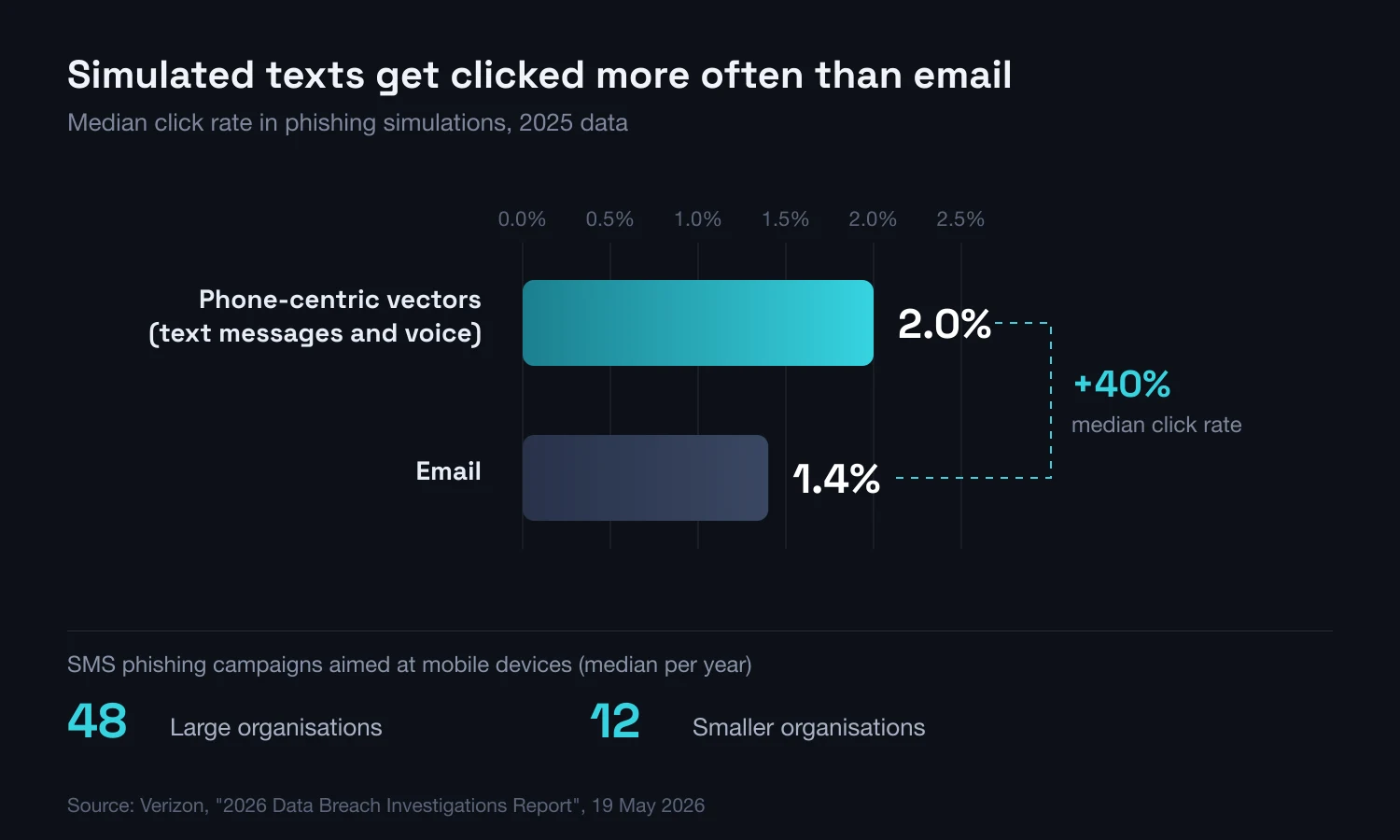
In simulations the difference is measurable. The median click rate in email campaigns was 1.4%, while campaigns run over phone-centric vectors sat closer to 2%, an increase of 40%. Verizon attaches a caveat to that figure which is worth repeating: far fewer providers run SMS and voice simulations than run email ones, so the sample for the phone channel is small. The direction is consistent with the rest of the data, though, and the order of magnitude is enough to stop treating SMS as a footnote.
The same report shows how often organisations meet this channel at all: the median number of SMS phishing campaigns aimed at mobile devices was 48 a year in large organisations and 12 in smaller ones. The important qualifier is that those campaigns were only visible because the devices were managed. A personal handset that an employee uses to read company mail appears in none of these statistics.
The view from the other side looks similar. The Anti-Phishing Working Group recorded 971,181 phishing attacks in the first quarter of 2026, up 13.8% on the previous quarter, while phone-delivered fraud, meaning vishing and smishing together, rose 15% over the same period. The most attacked brand category became telecoms, which jumped from 5.9% of all attacks in Q3 2025 to 33% in Q1 2026. That matters for the content of the lures: impersonating a mobile operator has stopped being a niche scenario.
Why SMS is effective
Not because it is clever, but because every layer of defence that email relies on simply disappears in this channel. The same link that passes through a gateway, domain reputation and a sandbox in email lands straight on the screen in a text. The properties that work in the attacker's favour:
- No headers. SMS has no equivalent of SPF, DKIM or DMARC, so there is no way to check who actually sent the message
- No corporate filter. An email gateway cannot see SMS traffic, and the only filtering happens in the operator network, against a pattern that has to exist first
- Trust in the channel. The same channel carries genuine authorisation codes and transaction alerts
- A device outside control. A personal handset has no policies, no agent and none of the logs a company laptop has
- A truncated address. A narrow screen shows the start of a domain, not the end, which is the part that decides where the link actually goes
- Shortened links are the norm here, so a shortener does not look out of place the way it does in email
- We read on the move. The decision takes seconds, usually while doing something else
The last point is the most awkward one for organisations. Smishing aimed at an employee almost always lands on a personal device that the security team cannot see, and cannot be expected to see. There is no telemetry to collect and nothing to block, so the incident surfaces only through its consequences: an unusual sign-in, a reset password, a transfer. That is a genuine hole in the BYOD model and no licence closes it. Procedure and a fast reporting route do.
How the attack works, step by step
Sending the message
The attacker sends texts with a spoofed sender ID. The message can then drop into the same thread that holds genuine notifications from a bank or courier.
Manufacturing urgency
The content creates time pressure and a small stake. A minor parcel surcharge, a blocked account, an unpaid invoice. The amount is deliberately low, because at a low amount nobody calls to check.
The fake page
The link opens a page imitating a payment gateway or a bank login. On a phone the address is truncated, so a swapped domain rarely stands out.
Draining the account
Credentials and the authorisation code reach the attacker in real time. The panel on the other side works as a relay: it retypes whatever was entered into the genuine banking session and asks for the code at exactly the moment it is needed.
Approving someone else's transaction
The code the victim retypes believing it authorises a surcharge of a few zloty authorises the attacker's operation instead, usually for a far larger sum. Increasingly the goal is not a single transfer but adding a trusted device or changing the contact details on file, because that buys access for longer than one session.
The Polish specifics: the 8080 number, patterns and statute
Poland has one of the better documented pictures of this in Europe, because it combines a dedicated free reporting channel on the number 8080 with a statutory duty to block. The figures below come from the CERT Polska annual report for 2025, published in April 2026:
- Over 350,000 messages analysed from reports sent to 8080
- Over 80,000 identified as harmful, the lowest count since 2022
- 790 smishing patterns developed and used to block campaigns
- Around 1.88 million malicious texts blocked, 27% more than in 2024
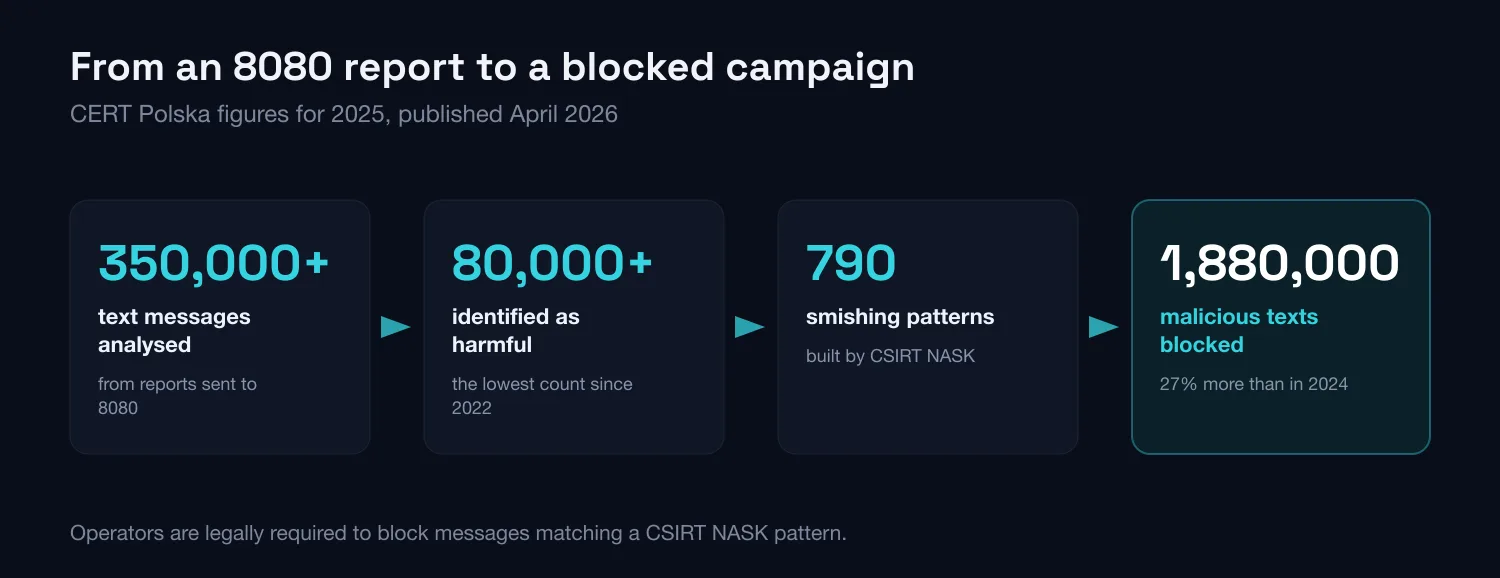
Those two numbers are worth reading together, because they move in opposite directions. Blocks rose by more than a quarter while harmful messages in reports hit their lowest level since 2022. The pattern mechanism does exactly what it was designed to do: a campaign blocked earlier reaches fewer people, so fewer people have anything to report. That does not shrink the phenomenon by itself. It moves the point at which the message gets stopped.
It is worth understanding that none of this rests on operator goodwill. The Act of 28 July 2023 on Combating Abuse in Electronic Communication requires CSIRT NASK to monitor smishing and build a message pattern, and requires telecoms operators to block texts matching such a pattern. Failure carries a penalty of up to 3% of an operator's annual revenue, plus a personal penalty for the responsible manager of up to 300% of monthly salary. Running a smishing operation is a separate criminal offence, punishable by three months to five years of imprisonment.
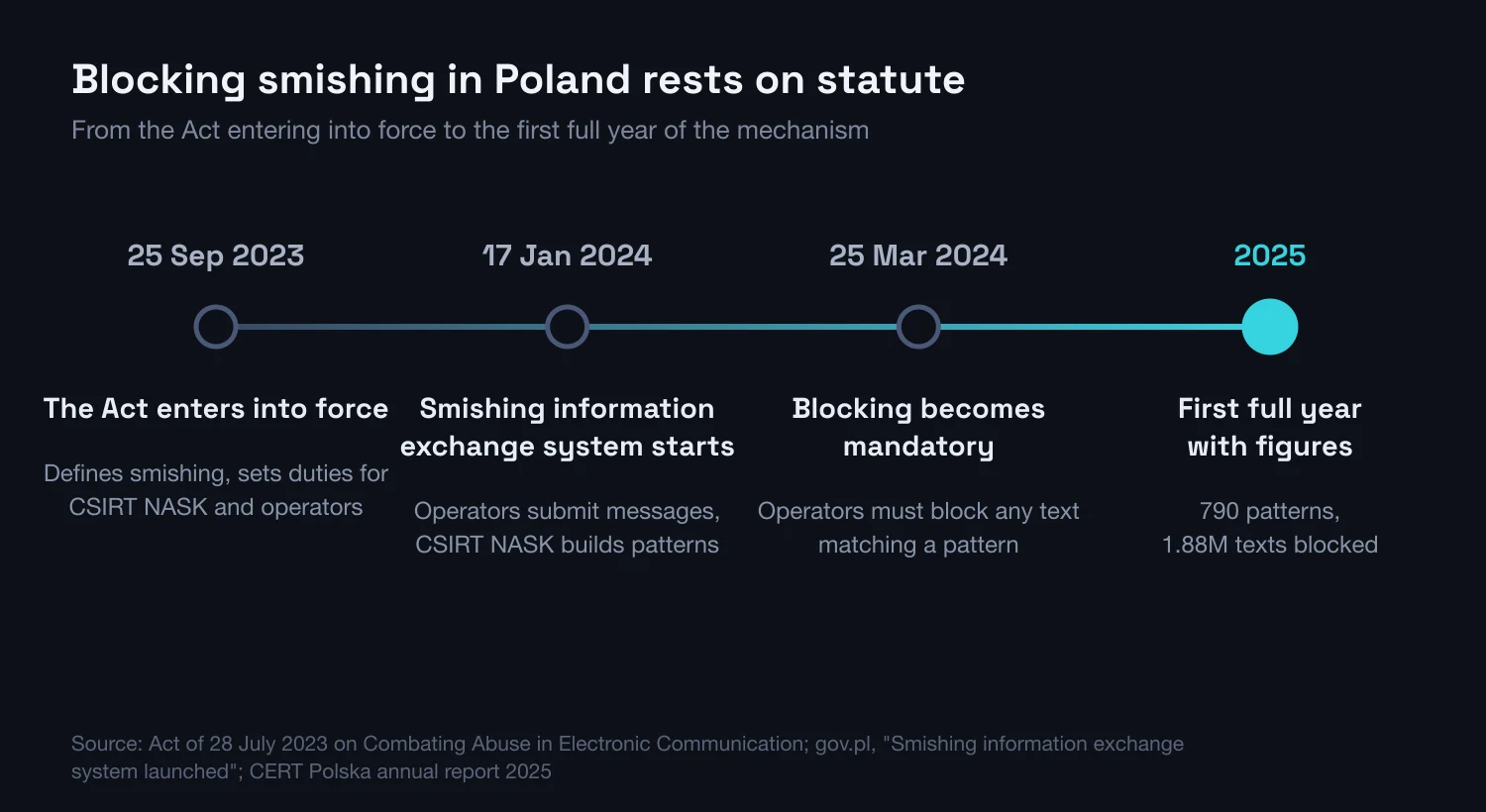
The machinery reached full strength in stages. The Act entered into force on 25 September 2023. The smishing information exchange system, through which operators submit suspicious messages and CSIRT NASK returns patterns, started on 17 January 2024. From 25 March 2024, blocking messages that match a pattern became an obligation rather than an option. That makes 2025 the first full year with figures from a working mechanism, and it explains why the number of blocks jumped by more than a quarter precisely then.
The second leg of the system is the Warning List of dangerous websites, run by CERT Polska since March 2020. A domain on the list is blocked at operator level, so even after a click the page will not open. In 2025 around 250,000 domains were added, 166% more than the year before, taking the list past half a million entries since launch and around 140 million blocked access attempts. It is a real second line, but it only starts working after a report, so the first hour in the life of a new domain stays uncovered.
The practical conclusion for an organisation is simple: reporting has an effect. All 790 patterns were built from messages passed on by people and by operators. Forwarding a suspicious text to 8080 takes about fifteen seconds, costs nothing on any operator in Poland, and shortens the campaign for every other recipient, not only for the person who reported it.
Sender ID spoofing: why the name on a text proves nothing
The sender field in an SMS is plain text. The protocol provides no authentication for it, so a bulk sender can put any string there and the handset will display it without objection. The side effect is worse than the forgery itself: the operating system groups messages by sender name, so a spoofed text can land in the very thread that holds genuine bank notifications, next to last week's authorisation codes. The thread context then does the work of credibility.
Polish law tries to close at least part of that gap. CSIRT NASK maintains a register of sender IDs reserved for public entities, and the President of UKE maintains a public register of SMS integrators authorised to send on their behalf. Operators are required to block a message carrying a reserved sender ID if it was not sent through a listed integrator. The register is deliberately split into a public part, the list of sender IDs that can be trusted, and a confidential part, the catalogue of malicious variants of those names, so as not to hand attackers a list of what they have yet to try.
The limit of that mechanism matters for private readers and organisations alike. Sender ID protection covers public entities, not every brand. A bank, a courier or a retailer has no automatic place in that register, so a sender name suggesting a private company remains a field that must not be treated as proof. The working rule has not changed in years: a sender name is not an identity, and the thread a message sits in is not authentication.
What the operator cannot block: SMS blasters
Those 1.88 million blocked messages are a ceiling, not a floor. The figure only covers texts that travelled through the operator network, because that is the only place where content can be matched against a pattern. A second delivery path is growing alongside it, and none of that machinery applies to it.
An SMS blaster is an IMSI catcher configured for the job, a device that impersonates a mobile base station. It fits in a car boot. Phones within range attach to it instead of the operator network and are then forced down to 2G. On 2G the network never authenticates itself to the handset, so the device can push a message with any sender ID straight onto the screen. No pattern and no operator filter sees it, because the message never enters the network.
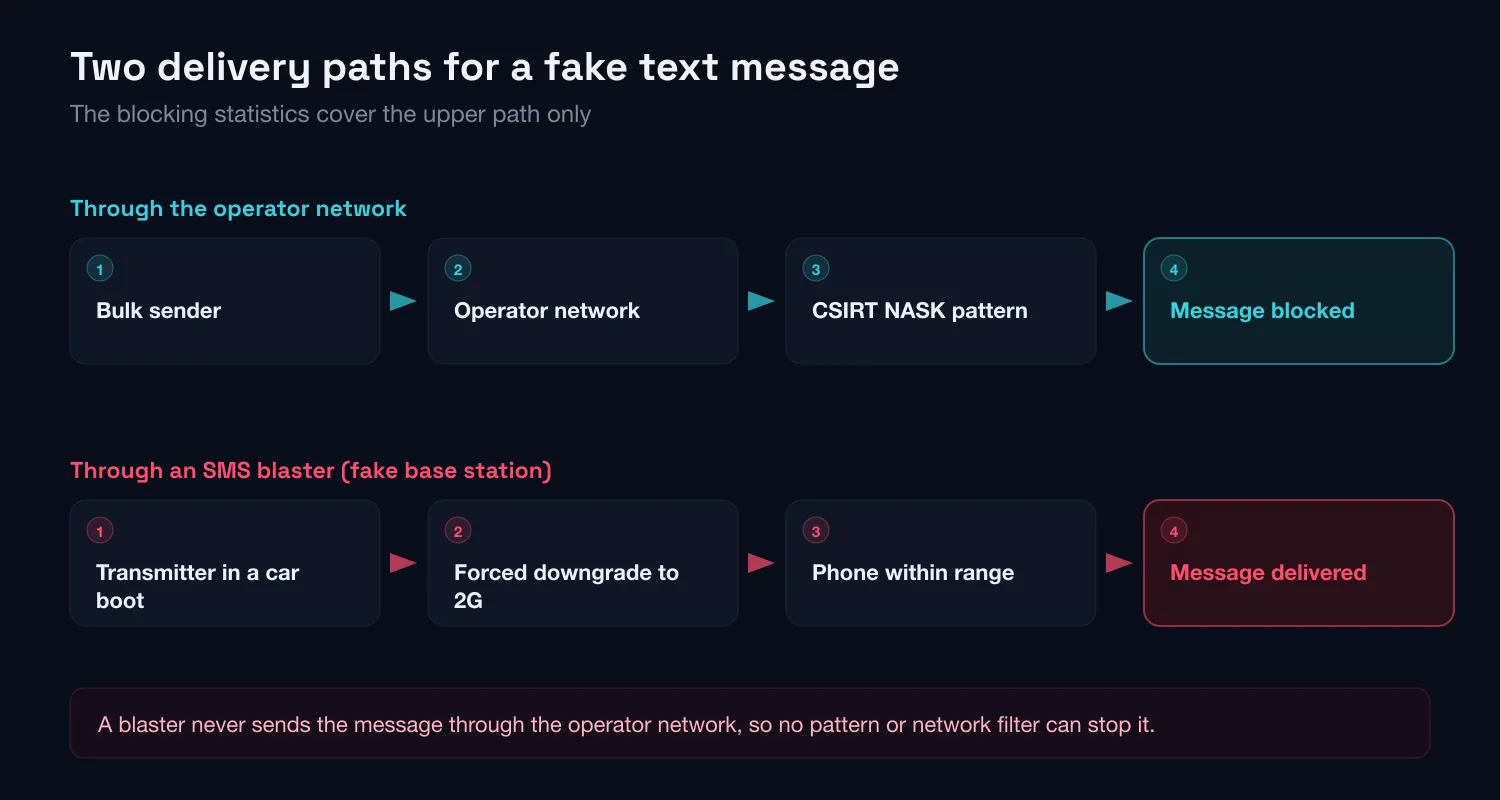
This is neither theoretical nor exotic. The mobile industry has named the problem, and courts have already handed down sentences:
- GSMA, September 2025: the Asia Pacific operator taskforce described SMS Blasters as portable fake base stations that fit in a car boot or a backpack, auto-configure to the surrounding network and require no technical expertise to operate, and called on governments and law enforcement for support
- United Kingdom, March 2025: a student from China drove an SMS Blaster around London in the boot of a car for six days, pushing lures at tens of thousands of potential victims; he was stopped while the device was running, and officers nearby received fraudulent texts carrying the tax authority sender name
- United Kingdom, June 2026: a second man from the same investigation was sentenced to 48 months in prison for supplying articles for use in fraud, in a case run by City of London Police
No case has been publicly confirmed in Poland, but the hardware is the same across Europe and CSIRT NASK patterns by definition do not reach it. The defence is different from the usual one too, because it sits on the phone rather than in the network. Android 12 and later expose an "Allow 2G" toggle in the mobile network settings. On iPhone, 2G and 3G are switched off together with Lockdown Mode. That single setting closes the whole path, at the cost of coverage in places where only 2G remains.
A blaster is the extreme case of a broader rule: network-side filtering only works on what travels through the network. The same gap applies to bulk SMS gateways rented outside the recipient's country and to SIM cards bought in volume for sending from handsets. That is why the sentence "the operator will block it" is only conditionally true, and makes a poor foundation for a corporate procedure.
RCS and iMessage: the same script in an encrypted channel
Phones stopped receiving only SMS a long time ago. RCS on Android and iMessage on Apple devices look identical to an ordinary text in the inbox, but technically they are messengers: the traffic is end-to-end encrypted and travels over the internet rather than the operator signalling network. The consequence for defenders is direct and inconvenient. The operator cannot see the content, so there is nothing to match against a CSIRT NASK pattern, and the statutory duty to block refers to SMS messages.
Filtering then moves into the app on the handset and into user reports, which, as the GSMA points out, is what operators lean on to detect campaigns that bypass the network. For the reader that means one thing: the visual advantage of the newer channel, meaning nicer formatting, images, read receipts and a sender profile with a name and a logo, is not proof of authenticity but better staging. The criterion stays what it was for SMS: whether the message asks you to open a link and hand over data nobody legitimate needs.
The most common scenarios
Campaigns recycle a handful of proven templates, and knowing them in advance handles most of the problem. The table below reads in one direction: from the pretext, through what the message is really asking for, to the signal that settles the matter without opening any link.
| Scenario | Pretext | What it really asks for | Signal that gives it away |
|---|---|---|---|
| Parcel surcharge | "Package held, a small additional payment is required" | Card details on a spoofed payment gateway | Carriers do not collect surcharges through a link in a text; check the parcel in the carrier app or by tracking number |
| Bank account blocked | "We detected a suspicious transaction, confirm your identity" | Username, password and an authorisation code in real time | Banks do not ask you to log in through a link or to send a code back; a code authorises the operation described in it, never a "verification" |
| Unpaid tax or official fee | "Tax arrears, interest is being charged" | A card payment or a banking login | A genuine case is visible in the official tax or citizen portal; a text with a link is not a settlement channel |
| Operator invoice | "Unpaid invoice, service will be cut off today" | A fast card payment | No invoice number and no contract number, and the reply number is an ordinary mobile instead of the operator sender ID |
| Energy supply cut-off | "Disconnection today at 14:00 due to arrears" | An immediate transfer or card details | A deadline counted in hours; genuine demands for payment arrive in writing and allow far longer |
| Message from a family member | "Mum, I lost my phone, this is my new number" | A transfer or an instant payment code | A request for money from an unknown number; call back on the number already saved in your contacts, not the one in the message |
One rule runs through all of them, regardless of pretext. Every scenario asks for an action that the institution in question never initiates by text: handing over card details, logging in through someone else's link, or retyping a code. As long as verification happens through the channel the sender chose, all we are checking is what the attacker wanted us to see.
How to recognise a fake bank text
A row-by-row comparison works better than a list of warnings, because genuine notifications are also terse and also sometimes alarming. The difference is not the tone but what the message asks for and where it leads.
One row deserves a sentence of its own, because the Polish Banks Association repeats it in every awareness campaign: a bank does not ask for login credentials in a text message. If a message asks, the matter is settled, no matter how the sender name looks or which thread it sits in.
- Calling back the number in the message. That is the attacker's number. The only safe numbers are the one on the back of your card, the one in the banking app, or the one on the official site you typed in yourself.
- Treating the sender name as proof. The sender ID in an SMS is not authenticated, and the operating system groups messages by that name, so a forgery can land in the thread holding your genuine codes.
- Paying "a couple of pennies for peace of mind". The amount is small on purpose, because at two zloty nobody calls to check. What you pay is not the amount but the card details that go into the form.
- Deleting the message as soon as you realise what happened. Without the content and a screenshot there is nothing to forward to 8080 and nothing to attach to a police report. Screenshot first, then report, and only then delete.
The first 60 minutes after a click
Order matters here more than speed. First you cut off the instrument that can move money, then access to the account, and only then do you file reports. The procedure below assumes the worst case: card details or login credentials have already been entered.
- 0–5 minutesThe person who clickedStop and document
Close the page and enter nothing further, even if the form asks for "one last code". Take a screenshot of the message including the sender name, and a screenshot of the open page. That is the material for the report and for any police statement, and it cannot be recovered once the message is deleted.
- 5–15 minutesThe person + the bankBlock the card and tell the bank
Block the card in the banking app or by phone. If you cannot reach the app, the Polish Banks Association runs a nationwide card blocking service on 828 828 828, staffed around the clock, which transfers you to the right bank. Call only the number on the back of the card, in the app, or on the official site, never the number from the message.
- 15–30 minutesThe person who clickedCut off account access
From a different, trusted device, change the banking password and the password on the mailbox used at registration. Review trusted devices, saved payees, transfer limits and contact details. If the same password is used elsewhere, change it there too, because data from the form circulates well beyond this one campaign.
- 30–45 minutesThe person or the security teamReport through the channel that actually blocks
Forward the text to 8080 using the forward function. Report the page address through the form at incydent.cert.pl. The first report feeds the pattern distributed to operators; the second sends the domain to the Warning List, after which the page stops opening for customers of Polish operators.
- 45–60 minutesThe affected personNotify law enforcement
If money was lost or someone else's transaction was approved, file a report with the police and attach the screenshots, the sender number or sender ID, and the times involved. Notifying the bank and filing a police report are two separate things and one does not replace the other.
- First 24 hoursSecurity teamCheck whether this was only the beginning
If the affected person has access to company resources, treat this as an identity incident: review the last day of sign-ins, revoke sessions, and check mail forwarding rules and any authentication methods registered after the event. We describe the same pattern under account takeover that bypasses MFA.
Two steps in this procedure are habitually done too late. Blocking the card gets postponed until the call with the bank, although it takes seconds in the app. Reporting to 8080 gets skipped because "the matter is handled anyway" — and it is the only step on the list that protects anyone other than the person reporting.
How to protect your organisation
Smishing aimed at employees is awkward, because corporate controls usually stop at the work laptop while the message arrives on a phone the organisation cannot see. The controls below run from those that work regardless of anyone's awareness to those that build it.
- Replace one-time SMS codes with phishing-resistant authentication everywhere the application allows it
- Apply MDM policy to phones with access to company data, and for personal devices set a written BYOD minimum: screen lock, system updates, a separate work profile
- Switch 2G off on company phones through MDM policy, to close the fake base station path
- State and enforce that company business never travels by text with a link, including messages from the board
- Build one reporting route that everyone knows, covering messages that arrive on personal phones too
- Write 8080 and incydent.cert.pl into the reporting procedure, so reporting does not depend on whether an employee remembers them
- Include SMS scenarios in your phishing simulation programme instead of limiting it to email
- Warn people about active campaigns during the week they are active; a timely alert beats a training session once a year
- Monitor accounts and sessions around the clock, for example through SOC-as-a-Service, because the fallout of successful smishing shows up in identity, not on the phone
- Rehearse the first-60-minutes procedure before you need it; if you have no such procedure, incident response is the place to start
One item on that list cannot be bought. Reports from people are the only source from which campaign-blocking patterns are built, and the only signal an organisation gets from a device it does not control. An awareness programme that penalises false alarms receives no reports after a few months, and loses the visibility along with them.
It is also worth remembering that SMS is one of several channels carrying the same social engineering, and separate training for each makes little sense. The same time pressure, the same request for a code and the same spoofed gateway appear in vishing with voice cloning and in QR code phishing. We cover every variant in our guide to types of phishing, and the wider picture of social engineering in finance in the Social Engineering Report 2026.
KEY TAKEAWAYS
- 1Outside the filter — email protection does not cover SMS, and the only filtering happens in the operator network, against a pattern that has to exist first
- 2The small amount is a technique — at two zloty almost nobody verifies, and the stake is the card details rather than the amount
- 3The sender name proves nothing — the sender ID field is not authenticated, so a fake text can land in the thread with genuine notifications
- 4Reporting works — all 790 patterns came from reports, and forwarding a message to 8080 is free and takes about fifteen seconds
- 5Blocking has a boundary — a text from a fake base station never enters the operator network, so no pattern covers it
- 6This is a BYOD problem — the attack lands on a personal device the organisation cannot see, so procedure and a fast reporting route replace telemetry
Frequently asked questions
Is simply opening a text dangerous?
No. Displaying the message does nothing on its own. The risk starts when you tap the link, call the number back, or send a code in reply. Do not delete the message straight away, because you will want it for the report.
I tapped the link in a text, what now?
It depends how far you went. If the page merely opened and you typed nothing, close it and you are done. If you entered login or card details, block the card in the app, change the password from another device and contact the bank on the number printed on the card. The full order of steps is in the "first 60 minutes after a click" section above. In every case, take screenshots before deleting anything.
Does reporting to 8080 cost anything?
No. Forwarding a suspicious message to 8080 is free on every operator in Poland. Just forward the text itself, no covering note needed.
Will the operator block every fake text?
No. Blocking covers messages that travel through the operator network and match a pattern built by CSIRT NASK. A fresh campaign therefore runs until a pattern exists, and a message sent from a fake base station never enters the network at all, so no pattern applies to it.
How did the scammers get my number?
Usually they did not target it. Campaigns run across whole number ranges or lists from earlier breaches, with no idea who will pick up. A fake base station does not even need the number: the phone only has to come within range of the device.
Can the sender name on a text be faked?
Yes. The sender field in an SMS is plain text that the protocol does not authenticate, so a bulk sender can put any name there. Handsets also group messages by that name, so a spoofed text can land in the thread holding genuine bank notifications. In Poland, statutory sender ID protection covers only reserved names of public entities, not brands in general.
Are RCS and iMessage safer than SMS?
For the privacy of a conversation, yes, because they are end-to-end encrypted. Against fraud, not really, and for the same reason: if the operator cannot see the content, it cannot match it against a pattern, and the statutory duty to block applies to SMS messages. Filtering moves into the app on the handset and into user reports, and better-looking message formatting is not evidence that the sender is genuine.
A fake text arrived on an employee personal phone. Is that a company matter?
Yes, if that phone reaches company mail, chat or an authenticator app. The organisation will not see the message in any system, so the only signal is a report from the employee, and the only way to get one is a reporting route that covers personal devices and carries no penalty for a false alarm. The consequences of a successful attack will surface in identity anyway, which is where the organisation is looking.
Conclusion
Smishing works not because it is sophisticated. It works because it catches a moment of inattention on a device nobody protects, and because every layer of defence built for email disappears in this channel. Poland has more tools here than most countries: a statutory duty to block, CSIRT NASK patterns, a sender ID register and a free reporting number. All of that machinery shares one bottleneck, a report from a human being, and one boundary, the operator network. Beyond it, all that remains are decisions made on a small screen in a few seconds, and the only way to prepare those is to practise them.
Your firewall cannot see text messages. Your employees see all of them, and they are the ones deciding.
Sources
- 1.Raport roczny z działalności CERT Polska w 2025 rokuCERT Polska / NASK · 2026-04 · accessed 2026-08-09CSIRT NASK annual report: 350,000 messages analysed from reports to 8080, more than 80,000 judged malicious (the lowest since 2022), 790 smishing patterns and close to 1.88 million texts blocked, plus 250,000 domains added to the Warning List.
- 2.Ustawa o zwalczaniu nadużyć w komunikacji elektronicznejCyberpolicy NASK · 2023-09-25 · accessed 2026-08-09NASK commentary on the Act: definitions of smishing and CLI spoofing, the duties of CSIRT NASK and telecoms operators, the registers under articles 10, 14 and 17, and the applicable penalties.
- 3.Wystartował system wymiany informacji o smishinguMinisterstwo Cyfryzacji, gov.pl · 2024-01-17 · accessed 2026-08-09Announcement of the smishing information exchange system launching on 17 January 2024, and of mandatory blocking of pattern-matching messages from 25 March 2024.
- 4.Lista Ostrzeżeń przed niebezpiecznymi stronamiCERT Polska · 2026 · accessed 2026-08-09Description of the Warning List of dangerous websites, plus instructions for reporting suspicious messages to the free 8080 number and through the incident form.
- 5.Wykaz integratorów usług SMS dla podmiotów publicznychUrząd Komunikacji Elektronicznej (BIP) · 2026 · accessed 2026-08-09Public register of SMS integrators authorised to send on behalf of public entities, maintained by the President of UKE under article 14 of the Act.
- 6.Karty bankowe — bezpieczne bankowanieZwiązek Banków Polskich · 2026 · accessed 2026-08-09What to do after losing control of a payment card, and the nationwide card blocking service on 828 828 828, staffed around the clock.
- 7.2026 Data Breach Investigations ReportVerizon · 2026-05-19 · accessed 2026-08-09Nineteenth edition; the dataset covers incidents between 1 November 2024 and 31 October 2025. Median simulation click rate: 1.4% for email and close to 2% for phone-centric vectors. Median of 48 SMS campaigns a year in large organisations and 12 in smaller ones.
- 8.Phishing Activity Trends Report, 1st Quarter 2026Anti-Phishing Working Group · 2026 · accessed 2026-08-09971,181 phishing attacks in Q1 2026, up 13.8% quarter on quarter; phone-delivered fraud (vishing and smishing) up 15%; the telecom sector accounted for 33% of all attacks.
- 9.GSMA Asia Pacific Mobile Industry Taskforce Calls for Government and Law Enforcement Support to Stamp Out SMS Blaster Device ThreatGSMA · 2025-09-23 · accessed 2026-08-09Position of the Asia Pacific operator taskforce on SMS Blasters: what the devices are, how they bypass the network, and a call for law enforcement support.
- 10.Man jailed for role in "SMS Blaster" fraud operation following City of London Police investigationCity of London Police · 2026-06-09 · accessed 2026-08-09Announcement of a 48-month custodial sentence for supplying an SMS Blaster, and of the earlier conviction of the man who operated the device in London in March 2025.
- 11.2G connectivity toggleAndroid Open Source Project · 2026 · accessed 2026-08-09Documentation of the "Allow 2G" toggle available from Android 12 onwards, including the rationale: protection against a forced downgrade to 2G by a false base station.
- 12.About Lockdown ModeApple Support · 2026 · accessed 2026-08-09Description of Lockdown Mode, in which Apple turns off 2G and 3G cellular support on iPhone and iPad, with a carve-out for emergency calls.
See how your team handles a text
Most training programmes stop at email. We also test smishing and vishing with voice cloning, the channels where employees are least prepared.