What is a SOC (Security Operations Center)?
A SOC is a team that monitors an organisation's systems around the clock, assesses alerts and responds to incidents. We explain what it does day to day, who works in it, which tools it uses, how it differs from MDR and a SIEM, what Poland's KSC Act says about it and what to ask a provider.
A SOC (Security Operations Center) is a team of people, processes and tools that continuously monitors an organisation's systems, assesses alerts and responds to security incidents. The acronym SOC has other meanings too: the SOC 2 audit report or a System on Chip. This article is only about the security operations centre, including the outsourced variant known as SOC as a Service.
What is a SOC
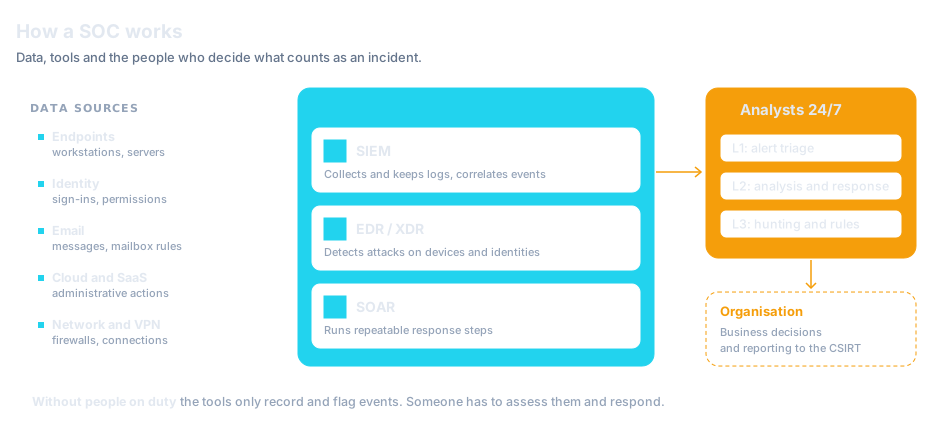
A SOC is a function, not a single tool. Tools collect events and flag the suspicious ones. SOC analysts decide which of them are an attack, establish its scope and start the response. Processes describe who does what and how fast: when an alert moves to the next tier, when to wake an administrator and when to inform the board.
A SOC can be a team inside the organisation, a service from an outside provider or a mix of both. Every variant has the same three parts: data from systems, tools to analyse it and people on duty. Without one of them the others lose their point. Tools without people only record events. People without data have nothing to assess.
A SOC works with what the organisation has already deployed. If a server does not send logs and a laptop has no EDR agent, the SOC will not see an attack on them. Before monitoring starts, it is worth checking which systems are connected and whether their data can be joined together. That is the job of security architecture and integration.
What a SOC does day to day
SOC work is a cycle: event, alert, assessment, response, lessons learned. A large share of the time goes into assessing alerts. In the SANS 2025 Detection and Response Survey, 73% of respondents named false positives as their top detection challenge. A typical scope looks like this:
- Continuous monitoring. Taking in events from endpoints, identity, email, cloud and network around the clock.
- Alert triage. Discarding false positives and prioritising the alerts that may mean an attack.
- Incident analysis. Establishing which accounts, devices and data the attack covers, how long it has been going on and how the attacker got in.
- Response. Isolating a device, blocking an account, removing a message, blocking an address. Actions that could stop the business need the system owner's decision.
- Threat hunting. Looking for traces of an attack that raised no alert, based on hypotheses and new attacker techniques.
- Detection engineering. Writing and tuning detection rules to cut false positives and cover new techniques.
- Reporting. Material for incident reports, reports for the board and evidence for audits.
Who works in a SOC: L1, L2 and L3
A SOC team is usually split into tiers. An alert goes to the first tier and moves on only if it needs deeper analysis. That way the most experienced people deal with attacks rather than false positives.
| Role | Tasks |
|---|---|
| L1 analyst | Takes in alerts, discards false positives, gathers basic information and escalates according to the procedure |
| L2 analyst | Analyses the incident, establishes its scope and course, leads the response and talks to administrators |
| L3 analyst | Runs threat hunting and malware analysis, handles the hardest incidents |
| Detection engineer | Writes and tunes detection rules, connects new data sources, looks after data quality in the SIEM |
| SOC manager | Owns the duty rota, procedures, metrics and contact with the board and system owners |
According to the SANS SOC Survey 2025, the most common size of a fully staffed SOC is 2 to 10 people, and the most common answer to how many people it takes to run a SOC was 10 full-time equivalents. Respondents still name the lack of skilled staff as the top challenge. With round-the-clock cover, every seat needs several people on the rota, with holidays and cover included.
SOC tools: SIEM, EDR and XDR, SOAR
There is no single "SOC system". A SOC uses several tools, each covering a different part of the work. Below we describe their role in SOC work; a full comparison of the four categories is in SIEM, SOAR, XDR and EDR: the differences (in Polish).
SIEM
A SIEM collects logs from many systems, keeps them and joins events according to rules. It is the main record of what happened in the organisation and the place where an analyst looks for traces from weeks ago. Details are in our article What is a SIEM and how it works.
EDR and XDR
EDR detects attacks on computers and servers from process behaviour and lets you stop them, for example by isolating a device. XDR adds data from identity, email, cloud and network. According to the SANS SOC Survey 2025, endpoint security alerts are the primary trigger for response for 85% of respondents. The differences are explained in What is XDR and how it differs from EDR.
SOAR
SOAR automates repeatable steps: it enriches an alert with data from other systems, opens a ticket and blocks an address or account once an analyst approves. Analysts spend less time on actions that look the same every time. More in What is SOAR.
Threat intelligence
Threat intelligence means lists of malicious addresses, domains and files plus descriptions of how specific groups operate. A SOC uses it to recognise a known attack faster and to know what to expect next. A separate source is information about leaked employee passwords, which lets you act before someone uses them.
The number of tools says nothing about the quality of a SOC. The SANS SOC Survey 2025 reports that 42% of SOCs send all the data they have to the SIEM. That increases the amount of data to search but says nothing about whether the detection rules cover the techniques attackers actually use to get in.
How a SOC handles an alert: an example
The example below is illustrative. It shows an alert moving through the tiers at night, when nobody from IT is in the office.
- 02:14EDRAlert: admin tool on an accounting workstation
A remote command execution tool starts on a computer in the accounting department. The user logged off in the evening.
- 02:19L1 analystTriage
The analyst checks whether this is a scheduled admin task. There is no such ticket, and the account that started the tool signed in earlier from an unusual address. The alert goes to L2.
- 02:31L2 analystAnalysis and isolation
The analyst finds that the same account connected to two servers. They isolate the workstation from the network and block the account under the agreed procedure.
- 02:50L2 analystNotifying the organisation
The on-call administrator gets a phone call with a description of the incident and a list of steps. The decision to shut down servers belongs to the organisation.
- 08:00SOC managerReport and notification
The organisation receives a report with a timeline, a list of accounts and devices, and the material needed for an early warning if the incident must be reported.
Without anyone on duty, the same alert would wait until morning in the EDR console. The attacker would have several hours to move on to other systems.
Why a SOC works around the clock
Attacks are not limited to IT office hours, and the time between an attacker getting in and their next step keeps shrinking. The data below shows what SOC work looks like and how fast attackers move.
| Measure | Value | Source |
|---|---|---|
| SOCs operating 24/7 | 79% | SANS SOC Survey 2025 |
| Most common size of a fully staffed SOC | 2–10 people | SANS SOC Survey 2025 |
| SOCs reporting metrics manually or mostly manually | 69% | SANS SOC Survey 2025 |
| False positives as the top detection challenge | 73% (64% a year earlier) | SANS 2025 Detection and Response Survey |
| Lack of skilled staff as a top detection challenge | 59% | SANS 2025 Detection and Response Survey |
| Median time from the attacker's entry to detection | 14 days (11 days a year earlier) | Mandiant, M-Trends 2026 |
| Intrusions the organisation detected itself | 52% (43% a year earlier) | Mandiant, M-Trends 2026 |
| Median time from initial access to its hand-off to a second group | 22 seconds in 2025 (more than 8 hours in 2022) | Mandiant, M-Trends 2026 |
| Reports to CERT Polska and incidents registered in 2025 | 658,320 reports, 260,783 incidents | CERT Polska / NASK |
The M-Trends data shows two things at once. Organisations detect intrusions themselves more often, but attackers need less and less time to pass the access on. A team that only starts its analysis in the morning cannot keep up with that pace.
In-house, outsourced or hybrid SOC
The choice of model depends on whether the organisation can staff a round-the-clock rota and keep people with the right skills. Each model has its limits.
| Model | When it fits | What to watch |
|---|---|---|
| In-house | A large organisation with its own security team that can staff a 24/7 rota | Hiring and keeping people, cover, developing detection rules on its own |
| Outsourced (SOC as a Service) | An organisation without a team for 24/7 duty, or one that needs it quickly | Provider access to systems, scope of response permissions, where data is processed |
| Hybrid | An organisation with an IT or security team during working hours that outsources nights, weekends or specialist tasks | A clear split of responsibilities and hand-offs between teams |
The SANS SOC Survey 2025 describes monitoring and incident response as areas where hybrid models are common: an in-house team does part of the work and an outside provider covers overflow or specialist tasks. Respondents outsource penetration testing and red teaming more often than they run them in-house.
SOC, SIEM and NOC: the differences
| Term | What it is | Relation to a SOC |
|---|---|---|
| SOC | A team, processes and tools for monitoring and responding to incidents | The umbrella term |
| MDR | A managed detection and response service, usually built on EDR or XDR | A narrower variant of an outsourced SOC, focused on telemetry from endpoints, identity and the cloud |
| SIEM | A tool for collecting, keeping and correlating logs | One of the tools a SOC uses |
| NOC | A network operations centre that looks after network and service availability and performance | A different goal: the NOC keeps systems running, the SOC keeps them from being taken over |
The line between a SOC and MDR is often blurred in offers. When comparing, ask about the list of data sources, the scope of response and who writes the detection rules, not about the name of the service. The differences are covered in What is MDR (article in Polish).
A SOC and Poland's KSC Act
Poland's National Cybersecurity System Act, as amended in 2026, does not use the word SOC, but it describes what a SOC does. Article 14 says that an essential or important entity sets up internal structures responsible for cybersecurity or signs a contract with a managed cybersecurity service provider. So the act allows your own team, an outside service or a combination of both.
Article 8(1)(2)(g) requires the information system used to provide the service to be covered by continuous monitoring. The act does not mention "24/7 duty", but continuous monitoring without people to assess an alert at night does not serve its purpose.
Article 11 sets the deadlines for reports to the competent sector CSIRT: an early warning no later than 24 hours after a major incident is detected, a notification within 72 hours and a final report no later than one month after the notification. To meet them, you need to know within the first day what happened and which systems are affected. That is SOC work. Public-sector obligations are described on our page the KSC Act in a public entity (in Polish).
For local government units, Article 16e allows joint handling of these obligations or an agreement under which several units entrust them to one of them. This lets smaller municipalities use a shared team instead of building their own.
What to ask a SOC provider
Most problems with an outsourced SOC come from things left unsaid: what the provider sees, what it can do on its own and when it calls. Ask the questions below before signing.
- Which data sources the service covers and who is responsible for connecting them
- Whether analysts work around the clock, including weekends and holidays, and how shift hand-offs work
- Which actions an analyst can take alone and which need the organisation's approval
- How and how fast the organisation learns about an incident
- Who writes and tunes the detection rules and whether they reflect the organisation's environment
- Where data is processed and stored, and for how long
- Whether the provider prepares the material for incident reports within the KSC Act deadlines
- Which reports and metrics the organisation receives regularly
- What happens to data and access when the contract ends
The answers show whether the service covers the whole path from event to response or only forwards alerts.
Frequently asked questions
What is a SOC in one sentence?
A SOC (Security Operations Center) is a team of people, processes and tools that continuously monitors an organisation's systems, assesses alerts and responds to security incidents.
How does a SOC differ from a SIEM?
A SIEM is a tool that collects and correlates logs. A SOC is the team that uses the SIEM, assesses alerts and responds to incidents. A SIEM without analysts only records and flags events.
How does a SOC differ from MDR?
MDR is a narrower detection and response service, usually working on telemetry from endpoints, identity and the cloud, while a SOC usually covers the whole environment, including logs and compliance. The differences and questions for a provider are covered in What is MDR (article in Polish).
Who works in a SOC?
First, second and third-tier analysts, detection engineers and a SOC manager. L1 handles alert triage, L2 analysis and response, L3 threat hunting and the hardest incidents.
Does Poland's KSC Act require a SOC?
The act does not use the word SOC. Article 14 requires an essential or important entity to set up internal structures responsible for cybersecurity or to sign a contract with a managed cybersecurity service provider, and Article 8 requires continuous monitoring of the system.
Does a SOC have to work around the clock?
The KSC Act talks about continuous monitoring. In practice someone has to assess an alert at night and at weekends too. According to the SANS SOC Survey 2025, 79% of SOCs operate 24/7.
KEY TAKEAWAYS
- 1A SOC is a team, processes and tools that continuously monitor an organisation's systems, assess alerts and respond to incidents
- 2A SOC works with data from connected systems: what is not connected, it will not see
- 3Analysts are split into L1, L2 and L3, and the most common size of a fully staffed SOC is 2 to 10 people (SANS 2025)
- 4SIEM, EDR and XDR and SOAR are SOC tools, not a replacement for a SOC
- 5Poland's KSC Act requires continuous monitoring and either internal cybersecurity structures or a contract with a managed service provider
- 6When choosing a provider, what matters is the data sources, response permissions and how you are notified, not the name of the service
Sources
- 1.SANS 2025 SOC SurveySANS Institute · 2025-07-09 · accessed 2026-11-15SOCs operating 24/7: 79%. Most common size of a fully staffed SOC: 2 to 10 people; most common answer to how many people it takes to run a SOC: 10 FTE. Lack of skilled staff as the top challenge. Metrics reported manually or mostly manually: 69%. Endpoint security alerts as the primary response trigger: 85%. Sending all data to the SIEM: 42%. Monitoring and response often run in a hybrid model.
- 2.SANS 2025 Detection and Response SurveySANS Institute · 2025-12 · accessed 2026-11-15False positives as the top detection challenge: 73% (64% in 2024). Lack of skilled personnel as a top detection challenge: 59%.
- 3.M-Trends 2026Mandiant / Google Cloud · 2026-03-23 · accessed 2026-11-15Median time to detection 14 days (11 days a year earlier). Detection by the organisation itself 52% (43% in 2024). Median time to hand access off to a second group: 22 seconds in 2025, more than 8 hours in 2022.
- 4.Prawie 2 tys. zgłoszeń każdego dnia. Raport CERT Polska za 2025 rokCERT Polska / NASK · 2026-04-08 · accessed 2026-11-15In 2025 CERT Polska received 658,320 reports and registered 260,783 incidents.
- 5.Ustawa z dnia 23 stycznia 2026 r. o zmianie ustawy o krajowym systemie cyberbezpieczeństwa oraz niektórych innych ustaw (Dz.U. 2026 poz. 252)Sejm RP (ELI) · 2026-03-02 · accessed 2026-11-15Article 8(1)(2)(g) (continuous monitoring), Article 11(1)(4), (4a) and (4c) (24 hours, 72 hours, one month), Article 14 (internal structures or a contract with a managed cybersecurity service provider), Article 16e (joint handling of obligations by local government units).
Need someone on duty who assesses alerts at night too?
ZeroLayer SOC as a Service monitors endpoints, identity, email, cloud and network around the clock and processes data in the European Union. We agree the scope and data sources before the service starts.