What is XDR and how it differs from EDR
XDR collects data from endpoints, identity, email, cloud and network, and links related events into one incident. We explain what it adds to EDR, how it differs from SIEM, what it does not do without people on duty, when to adopt it and what to ask a vendor.
XDR (Extended Detection and Response) is a security system that collects data from endpoints, identity, email, cloud and network, links related events into one incident and lets you respond from a single console. The abbreviation XDR is also used in the names of displays, where it refers to a wide dynamic range. This article is only about XDR in cybersecurity. We explain what XDR adds to EDR, how it differs from SIEM and when it is worth adopting.
What is XDR
XDR started as an extension of EDR. An EDR system records events on computers and servers, recognises an attack by how processes behave and can stop it. We cover it in EDR: what it is and how it works (in Polish). XDR applies the same approach to more sources. That is what "extended" refers to: detection and response reach beyond the endpoint.
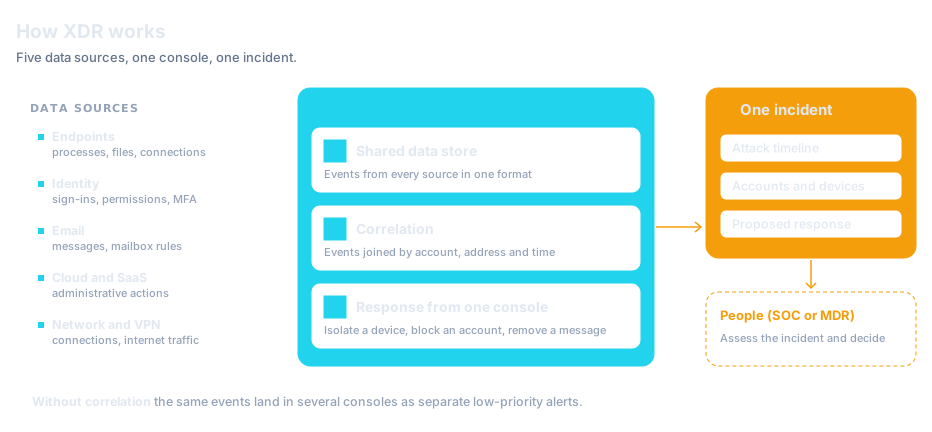
Every XDR platform has three parts. The first is the data sources: an agent on devices, plus integrations with the identity directory, email, cloud and network. The second is a shared data store with an analytics engine that looks for links between events from different sources. The third is the console. There the analyst sees the whole incident and triggers a response, such as isolating a computer or blocking an account.
XDR does not replace EDR; it includes it. The agent on the device remains the main source of data and the main place where response happens. If the agent is not running on every workstation and server, events from the other sources cannot be linked with what happens on the devices that lack it.
Five data sources in XDR: endpoints and four additional sources
Endpoints
The agent records process launches, file changes, network connections and sign-ins on workstations and servers. This is the part XDR shares with EDR. The response covers stopping a process, quarantining a file and cutting the device off from the network.
Identity
The source is events from the identity directory, for example Active Directory: sign-ins, permission changes and changes to authentication methods. This source shows a stolen password being used. An agent on a computer cannot tell such a sign-in from a normal one. Where such passwords come from is covered in our article on how an infostealer works (in Polish). The response is to require MFA, change the password or block the account.
Email provides information about phishing messages and their recipients, and about changes to mailboxes, such as a new forwarding rule. This shows which message the attack started with and who else received it. The response is to remove the message from every mailbox and sign the compromised account out.
Cloud
Cloud platforms and SaaS services record administrative actions: creating an access key, changing permissions, launching new resources, downloading data in bulk. An attack carried out entirely in a cloud console leaves no trace on any computer in the organisation, so EDR alone will not show it.
Network
Data from firewalls, VPN and network sensors shows connections between systems and traffic to and from the internet. It also covers devices that cannot run an agent: printers, cameras, controllers, network equipment. According to M-Trends 2026, exploiting a vulnerability was the most common way into an organisation (32% of intrusions). If the vulnerable system has no agent, the first trace of that entry is in the network data.
EDR vs XDR: how they differ
The difference between EDR and XDR is the range of data, not the way they work. Both judge how processes behave rather than relying on a file signature alone. Both can respond automatically.
In vendor offers the names EDR and XDR are sometimes used interchangeably. Some vendors call a product XDR when, apart from agent data, it only collects data from their own modules. So when comparing offers, ask for the list of sources and available response actions rather than the name of the category.
How correlation turns separate alerts into one incident
Correlation means linking events that concern the same user, device, address or file and follow one another within a short time. The example below is illustrative. It shows an attack in which each source records only one step.
- 09:12EmailA message with a link to a fake sign-in page
An employee in finance types their password into the fake page. Email protection flags the message as suspicious only after delivery. On its own: a low-priority alert.
- 09:31IdentitySign-in from a new device in another country
Someone signs in to the employee's account from an address nobody has used for that account before, and adds a new MFA method. On its own: it looks like a sign-in on a business trip.
- 09:44EmailA new mailbox rule
A rule appears in the mailbox that moves messages from the bank to the Archive folder. On its own: a change users make every day.
- 10:05Network and VPNA VPN session from the same address
A VPN session is opened with this account from the address used for the unusual sign-in. On its own: a valid authentication.
- 10:20EndpointAn administration tool on the file server
Someone uses this account to start a remote command execution tool on the file server. This is the first high-priority alert, more than an hour after the first step.
Without correlation these five events go to four consoles as five separate alerts, four of them low priority. The analyst has to notice on their own that they concern one account. An XDR platform joins them by account name, IP address and time. A single incident can be created as early as the second or third step, with a timeline, a list of accounts and devices, and a proposed response.
Correlation also shortens response time. Mandiant reports in M-Trends 2026 that the median time between initial access and its hand-off to a second threat group fell from more than 8 hours in 2022 to 22 seconds in 2025. Matching alerts from several consoles by hand takes longer than that.
What the reports say: how intrusions begin
According to M-Trends 2026, intrusions most often began with exploitation of a vulnerability. Voice phishing accounted for 11% of intrusions and email phishing for 6%. Verizon gives a similar share for vulnerabilities in the 2026 DBIR: 31% of breaches. ENISA, looking at incidents observed in the European Union, names phishing in a broad sense, including vishing, malspam and malvertising, as the intrusion vector in about 60% of cases.
| Measure | Value | Source |
|---|---|---|
| Intrusions that began with exploitation of a vulnerability | 32% | Mandiant, M-Trends 2026 |
| Intrusions that began with voice phishing | 11% | Mandiant, M-Trends 2026 |
| Intrusions that began with email phishing | 6% | Mandiant, M-Trends 2026 |
| Median time from initial access to its hand-off to a second group | 22 seconds in 2025 (more than 8 hours in 2022) | Mandiant, M-Trends 2026 |
| Median time from the attacker's entry to detection | 14 days (11 days a year earlier) | Mandiant, M-Trends 2026 |
| Intrusions the organisation detected itself | 52% (43% a year earlier) | Mandiant, M-Trends 2026 |
| Breaches that began with exploitation of a vulnerability | 31% | Verizon, DBIR 2026 |
| Share of phishing (including vishing, malspam and malvertising) among intrusion vectors in EU incidents | about 60% | ENISA Threat Landscape 2025 |
| Reports to CERT Polska and incidents registered in 2025 | 658,320 reports, 260,783 incidents | CERT Polska / NASK |
| Ransomware attacks recorded by CERT Polska in 2025 | 179 (21% more than a year earlier) | CERT Polska / NASK |
The figures come from different samples. M-Trends describes intrusions investigated by an incident response team, while ENISA describes incidents observed in the European Union. ENISA also counts phishing more broadly, including vishing, malspam and malvertising. That explains the difference in the share of phishing between the two reports. The conclusion is the same: attackers use several ways in, and each of them is recorded by a different data source.
CERT Polska's figures for 2025 show the scale of reports and incidents in Poland, including the number of ransomware attacks. We describe the course of such an attack and what to do in the first hour in Ransomware attack: what to do in the first hour (in Polish).
XDR vs SIEM: what each one is for
XDR and a SIEM system both combine data from many sources, so people often ask whether one can replace the other. In regulated organisations it usually cannot.
| Criterion | XDR | SIEM |
|---|---|---|
| Main purpose | Detecting an attack and responding | Collecting, storing and searching logs, and rule-based detection |
| Data sources | Sources for which the vendor has a ready integration and ready detections | Any log source, including business applications and industrial systems |
| Detection rules | Mostly supplied and updated by the vendor | Mostly written and tuned by the organisation's team |
| Response | Built in: device isolation, account block | Usually through a separate tool or by hand |
| Data retention | The period depends on the licence; the data is mainly for investigations | The organisation sets the period according to the law and its own policy |
| Evidence for audit purposes | The course of an incident from the sources the platform covers | Records from all connected systems and compliance reports |
A SIEM is still needed when logs have to be kept for a set period and presented to an auditor or supervisor. It is also needed for systems XDR has no integration with: line-of-business applications, databases, industrial equipment. The two categories increasingly overlap: XDR platforms are adding modules that collect logs from other vendors' systems, and SIEM systems are adding automated response. We set all four categories, SOAR included, side by side in SIEM, SOAR, XDR and EDR: the differences (in Polish).
Native and open XDR: two scenarios
Native XDR uses data from one vendor's products. Open XDR accepts data from different vendors' tools through ready-made integrations. The choice depends on what the organisation already has.
Scenario 1: the organisation is replacing endpoint protection and starting afresh
The organisation has old antivirus software and Active Directory. It has no separate tools for protecting identity or cloud. Here the native approach works well: one agent, one console and modules switched on one after another. The sources share a data format, so correlation needs no extra integration work. The limit: if the vendor has no module for an area, that area stays outside XDR.
Scenario 2: the organisation already has tools from several vendors
The organisation has working email protection, firewalls and an identity provider, and the contracts for those tools are still running. You need an XDR that accepts data from the existing tools. Before buying, check three things for each source: whether an integration exists, which events it passes on, and whether the XDR console can carry out a response in that tool or only displays its alerts.
The platforms we deploy and the scenarios they fit
SentinelOne Singularity is an EDR/XDR platform with a single agent for computers, servers and Kubernetes clusters. Its Storyline feature joins related processes, file changes and network connections into one attack sequence, and the Singularity Identity module detects attacks on identities in Active Directory and Entra ID. It fits scenario 1, including cases where the console has to run on premises or in an air-gapped network.
CrowdStrike Falcon uses a single sensor and a console in the vendor's cloud. The Falcon Insight XDR module records activity on the computer and shows the course of the attack. Identity protection analyses authentication in Active Directory and Entra ID and can require MFA or a password change. Further modules are switched on without installing new agents, which matches scenario 1. The Next-Gen SIEM module accepts logs from other vendors' systems, which matches scenario 2.
Cloud email is protected by a separate tool, for example Abnormal AI, which detects compromised accounts and can sign the attacker out. Whether signals from email reach the XDR console depends on the integrations available. We check this at the design stage, before licences are bought.
What XDR does not do
- It does not make business decisions. An automated response will block an account or isolate a laptop. A person decides whether to shut down a production server and whether to report the incident.
- It does not work without someone on duty. An incident detected at night needs someone to pick it up. That can be your own team, an MDR (Managed Detection and Response) service (article in Polish) or SOC as a Service. XDR run around the clock by an external team is in practice an MDR service. What a SOC is and how it handles alerts is explained in What is a SOC.
- It does not cover sources that are not connected. The scope of XDR ends with the list of integrations.
- It does not replace a log archive. Long retention and logs from any system are a job for a SIEM.
- It does not fix configuration. Missing MFA on remote access, out-of-date systems and excessive permissions have to be fixed separately.
- It does not assess the content of data. It will not recognise that a file sent by an authorised employee contains the customer database. That is a job for a DLP system.
Mandiant reports that in 2025 the median time from an attacker's entry to detection was 14 days, and organisations detected 52% of the investigated intrusions themselves. They learned about the rest from outside. A tool improves the chance of detection, but the outcome depends on whether someone reads the incidents and responds.
When EDR is enough and when to move to XDR
The order matters. XDR without the agent on every device gives you less than a well-deployed EDR.
EDR is enough when
- Most systems run on premises rather than in the cloud
- Email and accounts have basic protection and MFA
Finish the EDR deployment first when
- The agent is not yet running on every workstation and server. Install it on the remaining devices first.
- Nobody picks up alerts outside working hours. Sort out the rota first, because XDR will not change that.
XDR is justified when
- Email, files and applications run in the cloud and staff sign in through one identity provider
- Recent incidents started with a compromised account or phishing rather than a malicious file
- Analysts match alerts from several consoles by hand to work out the course of a single event
- The organisation falls under Poland's KSC Act and has to establish the scope of an incident quickly
- Staff and administrators connect remotely, so a large share of events happens outside the office network
XDR and Poland's KSC Act: the 24-hour and 72-hour deadlines
An essential or important entity sends the sectoral CSIRT an early warning of a significant incident within 24 hours, and an incident notification within 72 hours, of detecting it (Article 11(1)(4) and (4a) of Poland's KSC Act as amended, Journal of Laws 2026, item 252, in force since 3 April 2026). Who these duties apply to is covered in our article on NIS2 and the KSC Act.
XDR helps in two ways. First, it improves the chance that an incident is detected early, before it spreads to further systems. Second, the incident in the console contains a timeline and a list of the accounts and devices involved, which is the information needed for the early warning and the notification. The Act also requires the information system to be covered by continuous monitoring (Article 8(1)(2)(g) of the KSC Act as amended).
No tool ensures compliance with the Act. XDR does not replace a reporting procedure, designated people or a log archive. The Act does not name XDR or any other product category.
Questions to ask before buying XDR
- Which data sources the licence covers and which need separate modules
- Whether the platform accepts data from other vendors' tools already running in the organisation, and which events it takes from them
- Whether the console can carry out a response in those tools or only show their alerts
- Which fields the platform uses to join events into an incident, and whether you can test this in a pilot on your own data
- How long the platform keeps data and whether you can search it for the whole of that period
- Where the data is processed and whether you can choose a region in the European Union
- Which responses are automatic and which need approval, and whether this can be set separately for workstations and servers
- How incidents reach the SIEM and the IT ticketing system
- Who picks up incidents at night and at weekends: your own team, the vendor's service or an external SOC
How an XDR rollout goes
A rollout goes in stages. How long they take depends on the number of devices and sources, so we give no durations.
- Stage 1IT and securityInventory of sources and gaps
A list is drawn up of devices, identity directories, email systems, cloud accounts and network equipment, noting which sources are protected today.
- Stage 2Deployment teamThe agent on every device
The agent is installed on every workstation and server. The steps within this stage are described in EDR: what it is and how it works (in Polish).
- Stage 3Deployment teamConnecting identity
Identity is usually the first source after devices, because the account name links events from the other sources. Check that sign-ins and permission changes are visible in the console and are linked with events from devices.
- Stage 4Deployment team and system ownersEmail, cloud and network
Further sources are connected one at a time, with a controlled test after each. An event from the new source should end up in the same incident as the events from the device and the account.
- Stage 5SecurityAutomatic and manual responses
For each response you decide whether it runs automatically or after approval. Isolating a production server and blocking an administrator account are usually approved by a person.
- Stage 6On duty: in-house or SOCDuty cover and an exercise
Decide who picks up incidents at any hour and who prepares the report to the CSIRT. The ways of covering this duty are described in MDR: what it is and how it differs from SOC and EDR (in Polish). Test the whole arrangement in an exercise with a sample attack.
At ZeroLayer we design and deploy XDR on the SentinelOne and CrowdStrike Falcon platforms. Our team holds the SentinelOne Paladin and SIREN certifications. We connect the sources and test correlation as part of our security systems integration service. Incidents can be picked up by our SOC.
Frequently asked questions
What is XDR in one sentence?
XDR (Extended Detection and Response) is a security system that collects data from endpoints, identity, email, cloud and network, links related events into one incident and lets you respond from a single console.
What is the difference between EDR and XDR?
EDR collects data from computers and servers that run the agent, and responds there. XDR works the same way but adds data from identity, email, cloud and network, plus responses beyond the device, such as blocking an account. XDR does not replace EDR; it includes it.
Does XDR replace SIEM?
Usually not. XDR is for detection and response in the sources the vendor has a ready integration for. A SIEM keeps logs from any system for as long as the organisation decides, and provides evidence for audit purposes. More in What is SIEM and how it works.
When is EDR enough instead of XDR?
EDR alone is enough when most systems run on premises and email and accounts have basic protection and MFA. If the agent is not yet on every device, or nobody picks up alerts out of hours, it is too early for XDR. Finish the EDR deployment and sort out who is on duty first.
Does Poland's KSC Act require XDR?
No. The KSC Act does not name XDR or any other product category. It requires continuous monitoring, an early warning within 24 hours and a significant incident notification within 72 hours of detection. XDR helps you detect an incident earlier and establish its scope, but it does not ensure compliance.
Is SentinelOne an EDR or an XDR?
SentinelOne Singularity is an EDR/XDR platform with a single agent for computers, servers and Kubernetes clusters. The Singularity Identity module adds detection of attacks on identities in Active Directory and Entra ID. Details are on the SentinelOne page.
KEY TAKEAWAYS
- 1XDR collects data from endpoints, identity, email, cloud and network and links related events into one incident
- 2XDR includes EDR: the agent on devices remains the main source of data and the place where response happens
- 3Correlation joins events by account, address and time, so several low-priority alerts become one incident
- 4A SIEM is still needed for long log retention and for systems XDR does not cover
- 5XDR needs people: someone has to assess the incident, at night and at weekends too
- 6Poland's KSC Act does not require XDR, but XDR helps establish the scope of an incident within the 24-hour and 72-hour deadlines
Sources
- 1.M-Trends 2026Mandiant / Google Cloud · 2026-03-23 · accessed 2026-11-11Initial infection vectors in 2025: exploits 32%, voice phishing 11%, email phishing 6%. Median dwell time 14 days (11 days a year earlier). Internal detection 52% (43% in 2024). Median hand-off time to a second threat group: 22 seconds in 2025, more than 8 hours in 2022.
- 2.Vulnerability exploitation top breach entry point, 2026 industry-wide DBIR findsVerizon · 2026-05-19 · accessed 2026-11-11News release on the 2026 DBIR: 31% of breaches began with exploitation of a vulnerability.
- 3.ENISA Threat Landscape 2025: EU consistently targeted by diverse yet convergent threat groupsENISA · 2025-10-01 · accessed 2026-11-17Press release on the report: 4,875 incidents from 1 July 2024 to 30 June 2025, phishing (including vishing, malspam and malvertising) as the intrusion vector in about 60% of observed cases.
- 4.Prawie 2 tys. zgłoszeń każdego dnia. Raport CERT Polska za 2025 rokCERT Polska / NASK · 2026-04-08 · accessed 2026-11-11658,320 reports, 260,783 incidents and 179 ransomware attacks (21% more than in 2024) in 2025. Text in Polish.
- 5.Ustawa z dnia 23 stycznia 2026 r. o zmianie ustawy o krajowym systemie cyberbezpieczeństwa oraz niektórych innych ustaw (Dz.U. 2026 poz. 252)Sejm RP (ELI) · 2026-03-02 · accessed 2026-11-11The KSC Act as amended: Article 8(1)(2)(g) (continuous monitoring) and Article 11(1)(4) and (4a) (early warning within 24 hours, notification within 72 hours of detection). Text in Polish.
Want to check which sources to connect to XDR?
We design and deploy SentinelOne Singularity in stages: from the agent on every device to identity and cloud. We run tests to confirm that events from different sources end up in one incident.