Supermarket refrigeration attack: what we know and what to check in OT
In October and November 2026 someone remotely switched refrigeration controllers in shops in France and then in other European countries into defrost mode. We set out the confirmed facts, Flare's data on 2,667 IP addresses with a controller interface reachable from the internet, including 107 in Poland, and a list of things to check in your OT network.
Overnight on 11–12 October 2026, refrigeration controllers in several hundred grocery shops in France were remotely switched into defrost mode. Three weeks later, shops in other European countries reported the same. Nobody has claimed responsibility for the attack and it has not been established how the attackers gained access. The first thing the French CERT-FR recommends is to disconnect these controllers from the internet and restore remote access only through a VPN or a protected network. This article sets out the confirmed facts, the findings of Flare.io's analysis and a list of things to check in your own OT network.
What happened in France and in the countries that followed
Refrigerated cabinets and cold rooms in a shop are run by a controller, a small industrial computer that holds the set temperature, starts defrost cycles and sends alarms. Controllers are part of OT (operational technology). OT systems control physical equipment, while IT systems process data. A service engineer usually connects to the controller remotely, through an interface opened in a browser.
Defrost mode is an ordinary function: the unit stops cooling for a short time and heats the evaporator to melt the ice. According to Flare's analysis, overnight on 11–12 October 2026 someone forced this mode in several hundred grocery shops in France. Flare, citing press reports, says that temperatures in some units reached 50°C, stock was destroyed and equipment overheated.
Further attacks followed overnight on 1–2 November. The Dutch public broadcaster NOS reported that temperatures were changed at at least 17 businesses in the Netherlands, and that similar reports came in from Belgium, Luxembourg, Sweden, Ireland and Estonia. According to the Irish broadcaster RTÉ, the problem affected 13 SuperValu stores in Ireland, where it has been resolved, dozens of shops in Belgium and Luxembourg, and a few in Sweden. In Finland, a few small stores of the K chain had refrigeration equipment faults the same night. The Finnish broadcaster Yle reported that the cause is being investigated and that hacking cannot be ruled out.
A spokesperson for Danfoss, which makes some of these controllers, told NOS that the systems attacked that night in the Netherlands were not on a secured network and had a default password. According to NOS, the company had already advised its Dutch customers on 13 October to disconnect the systems from the internet and reconnect them only over a secured network. The spokesperson described the attack as the same type as in France: defrost mode and slowly rising temperatures.
What CERT-FR recommends
CERT-FR, the French incident response team within the agency ANSSI, published alert CERTFR-2026-ALE-012 on 12 October about an incident targeting remote controllers of refrigeration installations. On 13 October it added further targeted equipment, and on 16 October it updated the recommendations. The alert lists four product groups: Copeland xweb, Dixell xweb, and the Danfoss AK-SC and AK-SM series. CERT-FR assesses that the attack campaigns are probably still under way.
The alert contains the following recommendations:
- Disconnect from the internet the listed units and any controller that has a public IP address
- Restore remote access only through a secure VPN or a protected network
- Firewall filtering that allows only the installer's IP addresses should be treated as a temporary measure, not a permanent fix
- Update the software on the controllers
- Change default passwords, and set Danfoss units to the "Strict" security level
- Check the defrost schedules stored in the configuration
- Compromised Danfoss units should be restarted or reset to factory settings and configured again
- Before you cut the data link to the installer, check the terms of your insurance policy
What Flare measured: 2,667 addresses with a controller interface reachable from the internet
Flare.io, a technology partner of ZeroLayer, published an analysis of the exposure of this class of device on 15 October and updated it on 11 November. Exposure here means that the controller interface responds to connections from anywhere on the internet. Flare's researchers did not log in to any device and did not test vulnerabilities. They used passively collected data only, and the figures are as of 13 October.
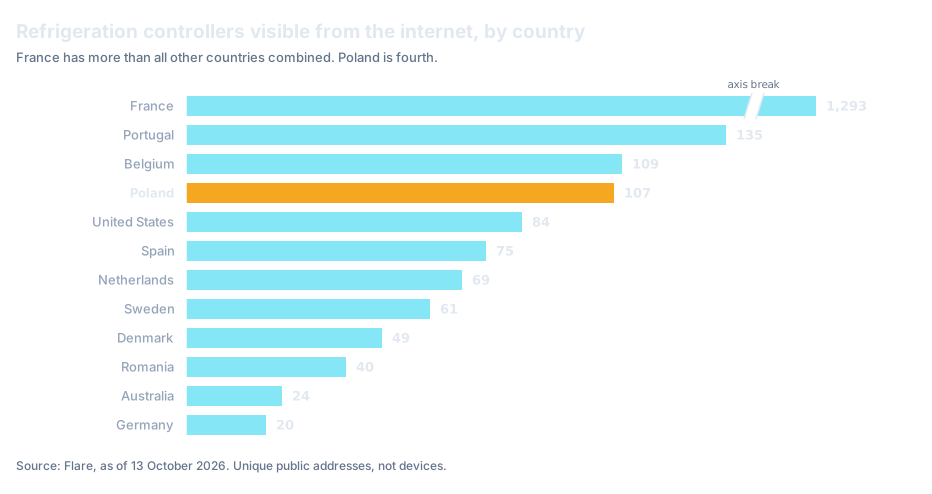
Flare counted 2,667 public IP addresses on which a refrigeration system management interface responds. This is the combined result of three search methods and should be read as a minimum. Under the method that returned the most complete results, 1,293 addresses are in France and 1,009 in all other countries combined. Poland has 107 addresses and ranks fourth, behind Portugal (135) and Belgium (109).
| Measure | Value | Notes |
|---|---|---|
| Public IP addresses with a refrigeration controller interface | 2,667 | Three search methods combined, a minimum value |
| Addresses in France | 1,293 | The method that gave the most complete picture |
| Addresses in all other countries combined | 1,009 | The same method |
| Addresses in Poland | 107 | Fourth place in the ranking |
| Addresses with more than one service | 65% | 356 of 547 confirmed addresses |
| Addresses serving interface files older than the 2025 login fix | 76.8% | 604 of 786 addresses with a readable date, an estimate |
| Rank | Country | Number of addresses |
|---|---|---|
| 1 | France | 1,293 |
| 2 | Portugal | 135 |
| 3 | Belgium | 109 |
| 4 | Poland | 107 |
| 5 | United States | 84 |
| 6 | Spain | 75 |
| 7 | Netherlands | 69 |
| 8 | Sweden | 61 |
| 9 | Denmark | 49 |
| 10 | Romania | 40 |
| 11 | Australia | 24 |
| 12 | Germany | 20 |
These figures are IP addresses, not physical devices: several controllers can sit behind one address. Flare does not name any organisation. In Poland there are 107 addresses at which a controller interface was reachable from the internet on 13 October. Flare does not say whether any of them was attacked.
Record counts and device counts
Flare also addresses the figure of 4,629, which has been quoted as a device count. It is the number of service records in one of the data sources. After duplicates are removed, 2,302 addresses remain. Eight addresses account for 2,205 records, because the same page responds on hundreds of ports at those addresses. In your own inventory it is therefore worth counting addresses and ports separately. Otherwise the result will be inflated.
Poland: 107 addresses in October, 101 at the start of November
In Flare's October figures Poland has 107 addresses and 109 records, so at almost every address the interface responded on a single port. In the update of 11 November Flare gives data collected on 1 and 2 November. At that point 101 Polish addresses remained in the data source, and 68 of them had been observed on or after 13 October. The remaining 33% were not observed again after that date.
| Measure | Value |
|---|---|
| Addresses with a controller interface, as of 13 October | 107 |
| Service records at those addresses, as of 13 October | 109 |
| Addresses remaining in the data source on 1–2 November | 101 |
| Addresses observed on or after 13 October | 68 |
| Addresses not observed again after 13 October | 33% |
| Records on ports 80, 443, 8080 or 8443 not observed again after 13 October | 38% |
| Incident similar to the November ones, as of 2 November | none reported |
Among Polish records on the usual web ports (80, 443, 8080, 8443), 38% were not observed again after 13 October, compared with 33% across all ports. Controller interfaces were also found on non-standard ports, so addresses need checking across the full port range. Flare lists Poland with Spain and Denmark as countries with a measurable number of reachable interfaces where no incident similar to the November ones had been reported by the time the data was collected.
Flare cautions that a record remaining in the data source does not prove that the address still responds, and that the percentages may reflect differences in how often addresses are scanned. These figures therefore do not show how many Polish controllers were disconnected from the internet after 13 October.
At most addresses the controller is not the only service
Flare checked what else responds at the same addresses. At 356 of 547 confirmed addresses, or 65%, more than one service responded. At the remaining 191 addresses only the controller responded.
| Service | Number of addresses | Why it matters |
|---|---|---|
| Remote desktop available through a browser | 72 | Leads to a computer at the same site, not only to the controller |
| Cameras and video servers | 42 | Another device with its own login interface and its own vulnerabilities |
| VPN (IPsec, OpenVPN, L2TP) | 78 | A VPN gateway is reachable from the internet by design. The controller should be reachable only after connecting to it |
| Controller only | 191 | The fewest services in this group, but the interface is still reachable from the internet |
Flare notes that this group of addresses was selected by one identification method and is not a random sample. The practical conclusion does not depend on that: if a controller responds at the address of a shop or a warehouse, every port on that address needs checking. We cover this in more detail in our article on shadow IT and the attack surface (in Polish).
A separate finding concerns how the interfaces are configured. In 1,024 of 1,026 responses examined, the interface accepted requests from any domain (a CORS policy with a wildcard). Flare did not test whether this setting makes it possible to control the device, or whether it is a factory default.
Stolen credentials: one finding, no proof of a link to the attack
Flare searched five sets of data stolen by infostealers, malicious programs that copy passwords saved in the browser. The sets came from about 3,400 infected computers. Flare found no credentials in them that referred by name to the interfaces of these controllers or to the manufacturer's cloud service.
It found one exception. A Windows computer infected in May 2025 held saved credentials for an IP address on which a refrigeration controller interface answered 16 months later. Flare notes that it has not been established whether those credentials were valid or whether anyone used them. No link to the October attack has been established either.
A single record is not enough to identify the method of attack. It does justify two actions: changing service passwords once the controllers are disconnected from the internet, and asking the service company which computers hold those passwords. We explain how this kind of malware works in our article on infostealers (in Polish).
Why updating alone is not enough
Flare describes a flaw in one of the controller families that was fixed in the first software release of 2025. It allowed the login to be bypassed, because a second authentication path accepted a code derived from the device's current date. According to Flare, it was the only one of the three vulnerabilities fixed in 2025 that could be exploited without logging in.
The software version cannot be seen from outside, so Flare used an indirect indicator: the date of the web interface files. Of 786 addresses with a readable date, 604, or 76.8%, served files older than the first 2025 fix. That date describes the interface, not the firmware, so the result is an estimate.
Updating is necessary because it removes known flaws. Neither an update nor a password change replaces disconnecting from the internet. Changing the password does not remove the login bypass on an unpatched device. An update removes only known flaws, and Flare lists vulnerabilities in interfaces of this class described in 2023, 2025 and 2026, so more should be expected.
What to check in your own OT network
The list combines the CERT-FR recommendations with Flare's conclusions. The same steps apply to controllers for air conditioning, building automation and other OT systems. In OT security the first thing to establish is which devices are reachable from outside the organisation.
- List the public IP addresses of every site: shops, warehouses and plants. Include internet connections ordered by the service company
- Check every address across the full port range, not only ports 80 and 443. Flare found controller interfaces on non-standard ports
- Remove port forwarding rules to controllers. Allow remote access only through a VPN or a gateway with authentication and a connection log
- Change default and service passwords once the controllers are disconnected from the internet
- Update the controller software and record the version and the date of the update
- Ask the service company in writing how it connects to the equipment (we cover supplier access risk in our article on supply chain attacks, in Polish), which accounts exist, which computers hold the passwords and when they were last changed
- Review the defrost schedules and temperature alarm thresholds in the configuration
- Decide who receives a temperature alarm at night and at the weekend, and what they should then do
- Repeat the address check regularly, including after every service visit
We describe regular checks of what in your organisation is reachable from the internet in our article on threat exposure management (in Polish). In our Intelligence service, which we run on the Flare.io platform, we monitor infostealer logs for leaked passwords of employees and service companies.
What is still not known
As of 17 November 2026 (the CERT-FR alert, Flare's analysis and media reports rechecked that day, with no new findings):
- The perpetrators. According to Flare, as of 2 November nobody had claimed responsibility, the attacks had not been attributed to any group and no ransom demand had been identified
- The access method. The manufacturer confirmed a default password only for the systems attacked in the Netherlands. For the attack in France the method has not been established
- The link between the October and November attacks. The mechanism is the same, but Flare notes that this does not prove that the same perpetrators or a single access method were involved
- The scale of compromise. Flare's data describes which interfaces were reachable from the internet, not the number of intrusions
- Finland. Yle reports that the cause of the faults at K-stores is being investigated
Frequently asked questions
What did the attack on supermarket refrigeration systems involve?
Someone remotely switched refrigeration controllers into defrost mode, so the temperature in cabinets and cold rooms rose. According to Flare, overnight on 11–12 October 2026 this affected several hundred grocery shops in France. Overnight on 1–2 November, similar events were reported in the Netherlands, Belgium, Luxembourg, Sweden, Ireland and Estonia.
Does the attack affect Poland?
As of 17 November 2026, none of the sources we used describes an attack in Poland. Flare did, however, count 107 Polish IP addresses with a refrigeration controller interface reachable from the internet (as of 13 October), which puts Poland fourth in the ranking. At the start of November 101 such addresses remained in Flare's data. CERT-FR recommends disconnecting such controllers from the internet. Flare does not say whether any of these addresses was attacked.
What is OT, and how does OT security differ from IT security?
OT (operational technology) covers systems that control physical equipment: refrigeration, air conditioning, production lines. The result of an attack on OT is a physical change, such as a rise in temperature. OT devices run for years, rarely receive updates and are often maintained by an external service company. That is why OT cyber security is based on disconnecting devices from the internet and controlling remote access.
Is changing the controller password enough?
No. CERT-FR recommends first disconnecting the controller from the internet and restoring access only through a VPN or a protected network. Flare describes a flaw in one controller family, fixed in 2025, that allowed the login to be bypassed regardless of the password, and most of the interfaces it examined had files older than that fix. Change the passwords once the controller is disconnected from the internet.
How do I check whether a controller is reachable from the internet?
Identify the public IP addresses of your sites and check them from outside on all ports, yourself or with a provider that monitors exposure. If the controller login interface opens from outside the company network without a VPN connection, the device is reachable from the internet.
Which controllers does the CERT-FR alert cover?
Alert CERTFR-2026-ALE-012 lists four product groups: Copeland xweb, Dixell xweb and Danfoss controllers from the AK-SC and AK-SM series. According to Flare, the XWEB line is sold under both the Copeland and Dixell names. CERT-FR recommends disconnecting these units from the internet and restoring remote access only through a VPN or a protected network.
Summary
The access method used in France has not been established. The manufacturer confirmed that the systems attacked in the Netherlands were not on a secured network and had a default password. CERT-FR recommends first of all disconnecting the controllers from the internet, so the first step is an inventory of addresses and disconnecting the interfaces from the internet. Updates, password changes and arrangements with the service company come next.
KEY TAKEAWAYS
- 1Overnight on 11–12 October 2026, refrigeration controllers in several hundred shops in France were remotely switched into defrost mode, and overnight on 1–2 November similar events were reported in six more countries
- 2In alert CERTFR-2026-ALE-012, CERT-FR recommends disconnecting controllers from the internet and restoring access only through a VPN or a protected network
- 3Flare counted 2,667 public addresses with a refrigeration controller interface, including 1,293 in France and 107 in Poland
- 4At 65% of the addresses examined other services were running as well, including remote desktop, cameras and VPN
- 5Changing the password is not enough: a flaw in one controller family, fixed in 2025, allowed the login to be bypassed, and by Flare's estimate 76.8% of the interfaces examined had files older than that fix
- 6The perpetrators, the access method and the link between the October and November attacks have not been established
Sources
- 1.Analysis After the Refrigeration System Attack in FranceFlare · 2026-10-15 · accessed 2026-11-11Analysis of refrigeration controller exposure, published on 15 October 2026 and updated on 11 November 2026. Figures as of 13 October 2026. The source of all data on addresses, services, file dates and credentials in this article.
- 2.CERTFR-2026-ALE-012: Incident de sécurité ciblant les contrôleurs à distance des installations de réfrigérationCERT-FR (ANSSI) · 2026-10-12 · accessed 2026-11-11Alert of 12 October 2026, revised on 13 and 16 October. List of equipment and recommendations. Text in French.
- 3.Ook koelsystemen in Nederland aangevallen, bij 17 bedrijven temperatuur aangepastNOS · 2026-11-02 · accessed 2026-11-11At least 17 businesses in the Netherlands, the Danfoss spokesperson's statement on the default password and unsecured network, the advice of 13 October. Text in Dutch.
- 4.Issues with refrigeration systems at 13 SuperValu stores after hack now resolvedRTÉ · 2026-11-02 · accessed 2026-11-1113 SuperValu stores in Ireland, dozens of shops in Belgium and Luxembourg, a few in Sweden.
- 5.K-kauppojen kylmälaitteissa ilmeni häiriötä samaan aikaan – hakkerointia ei voida poissulkeaYle · 2026-11-02 · accessed 2026-11-11Temperature faults at a few small K-stores in Finland, cause under investigation. Text in Finnish.
Check whether your organisation's passwords are in infostealer logs
As part of the Intelligence service, we run Flare.io for you: we look for employee passwords and company data in infostealer logs and criminal sources, and analysts verify the findings.